

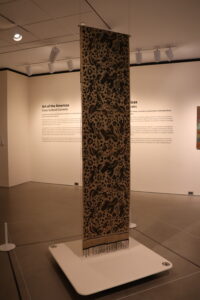
Artist once known
Northern Javanese; Indonesia
Selendang (shoulder cloth), ca. 1870–1920
Silk batik with hand-drawn wax resist
Gift of Jane Mitchell, 1986. (1986.32)
Indonesian women perfected this resist-dyed art—called batik—over the course of centuries. To create the elaborate patterns seen here, the maker drew the designs using a brush and hot wax. These waxed areas would remain white when the textile was dyed, creating striking contrast.
This shoulder cloth has a rhythmic design full of birds, monkeys, tigers, vines, and passion fruits. The bird motif (lokcan) was inspired by Chinese phoenixes which were popular symbols in Northern Java and the neighboring island of Bali during the late nineteenth century. The silk material and fashionable decoration seen here signified the wearer’s leisure and status.
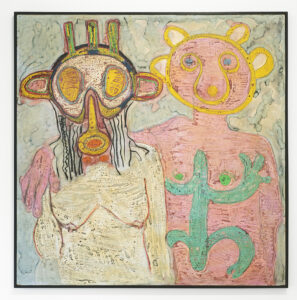
Nitza Tufiño
American, born Mexico, 1949
Pareja Taína (Taíno Couple), 1972
Acrylic, charcoal and polyurethane on Masonite
El Museo del Barrio, Museum Purchase through the support of George Aguirre, National Endowment for the Arts, Boricua College, the Reader’s Digest Foundation and individual contributions.
Nitza Tufiño found inspiration for this couple’s stylized features in the rock carvings made by the Taíno, an Indigenous people of the Caribbean. The man has a green coquí, or frog, on his chest, and a face that echoes Taíno depictions of the sun god. The woman’s face draws from the same design vocabulary, but resembles a gas mask, perhaps alluding to the Vietnam War.
Like other artists of Puerto Rican heritage in New York City during the 1970s, Tufiño used Taíno imagery to celebrate and empower her community. She became one of the leading artists in the Nuyorican Movement, a group which included poets, musicians, and artists creating work about the Puerto Rican experience in New York.
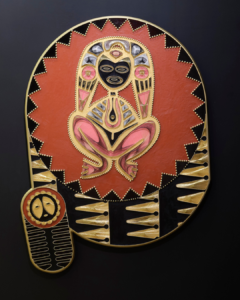
Glendalys Medina
American, born 1979
Atabey, 2022-2023
Plywood, nails, thread, chalkboard paint, ink, oil paint, and wire
El Museo del Barrio, Courtesy of the Artist
“The Indigenous people were the first graffiti artists.” – Glendalys Medina
Medina’s Atabey draws inspiration from rock carvings by the Taíno, an Indigenous people who lived and still live throughout the Caribbean. In doing so, Medina follows in the footsteps of an earlier generation of Nuyorican artists—like the makers of the neighboring works here who used Taíno imagery to offer diasporic Puerto Ricans a sense of identity and pride.
Medina creates a rich range of allusions with this work. Webs of string and wire suggest the speakers of a boombox, recalling the hip-hop culture that the artist grew up with in the Bronx. Nails evoke central African power figures, while the color gold to refers to Spanish colonizers’ desire for the precious metal as well as their descriptions of the “sun-kissed” Taíno complexion.
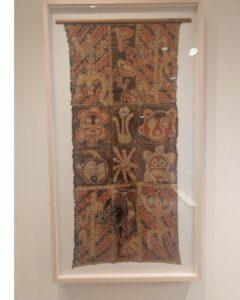
Wanda Maria Quiñones
American
Untitled (Taíno symbols), 1977
Linen batik
El Museo del Barrio
This textile draws inspiration from petroglyphs, or rock carvings, by the Taíno,
an Indigenous Caribbean people.
Do you notice any symbols in this textile that also appear in the artworks at left?
Angel Suarez-Rosado
American, born 1957
White Fence, 2003
Found objects, wood, paint
Purchase: The Ardath Rodale Art Fund, 2021.
(2021.7a, b)
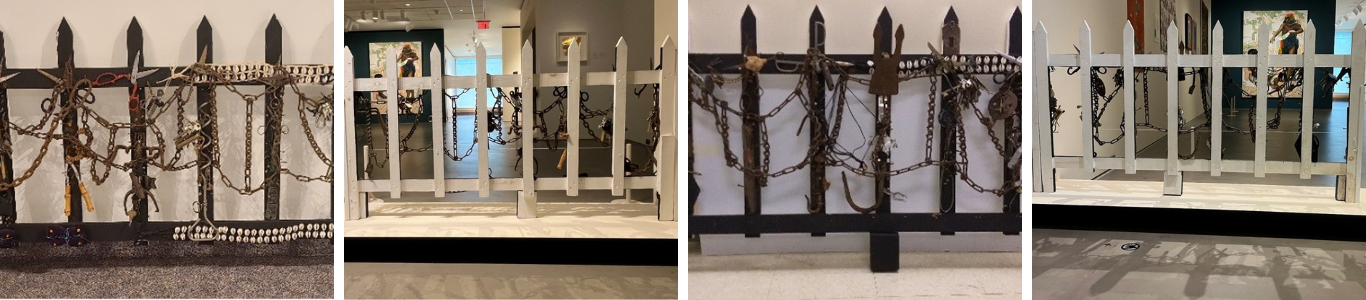
Puerto Rican-born, Easton-based Angel Suarez-Rosado plays with expectations in his installation White Fence. On approach, we see a white picket fence that suggests an uncomplicated American domestic ideal. Passing through, we encounter hybrid symbols of violence, pain, and great spiritual power.
Suarez-Rosado is a practitioner of Santería, an Afro-Cuban religion that merges elements of West African Yoruba faith with Catholicism, and was a means for enslaved Africans to maintain their identity in the Americas. In its use of sharp metal objects, nails, and tools, White Fence recognizes Ogun, the god of iron and war in the pantheon of Yoruban deities. Nails hammered into the surface of the fence recall nkisi, central African power figures whose forms were the result of both creation and use, contributed to by a sculptor and a priest, who used the figure to heal illness, settle disputes, and punish wrongdoers.
Artist once known
Northern Javanese; Indonesia
Selendang (shoulder cloth), ca. 1870–1920
Silk batik with hand-drawn wax resist
Gift of Jane Mitchell, 1986. (1986.32)
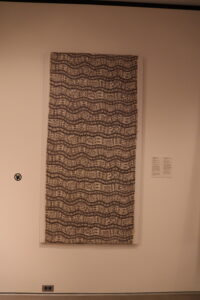
Indonesian women perfected this resist-dyed art—called batik—over the course of centuries. To create the elaborate patterns seen here, the maker drew the designs using a brush and hot wax. These waxed areas would remain white when the textile was dyed, creating striking contrast.
This shoulder cloth has a rhythmic design full of birds, monkeys, tigers, vines, and passion fruits. The bird motif (lokcan) was inspired by Chinese phoenixes which were popular symbols in Northern Java and the neighboring island of Bali during the late nineteenth century. The silk material and fashionable decoration seen here signified the wearer’s leisure and status.
Artist(s) once known
Bushoong, Kuba; Democratic Republic of the Congo
Ntshakishwepi (Woman’s Ceremonial Wrapper), mid‑twentieth century
Raffia palm fiber, appliquéd and embroidered
Purchase: The Reverend and Mrs. Van S. Merle‑Smith, Jr. Endowment Fund, 2003. (2003.6.2)
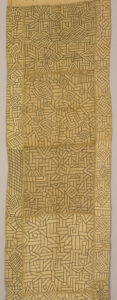
To create this ceremonial skirt, Bushoong men processed raw raffia palm fiber and wove cloth panels on which women embroidered and appliquéd geometric designs. The abstract patterns were typically asymmetrical and included hexagons, diamonds, rectangles, and triangles interlocked with one another. These complex arrangements of shapes–symbolic designs passed down through generations–would indicate the wearer’s identity and status within the Bushoong community.
Although displayed here flat, this textile would have been worn wrapped around the waist in a descending spiral, creating even more dynamic movement to this intricate design.
Clyde Connell
American, 1901–1998
Bistineau Sentinel No. 1, 1992
Paper-mache, stone, wood, metal
Purchase: The Gift of John and Fannie Saeger, 1994. (1994.4)
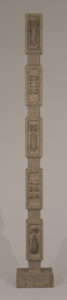
In her sculptures, Clyde Connell combined found materials from her home at Lake Bistineau, Louisiana, with paper pulp and glue to create a paper-mache that physically embodied her environment. She would then apply this paste to a wood and rock armature transforming it into a tall totemic structure. Connell’s symbols along the front and back of this sculpture represent her gestural translation of the sights and sounds of the swamplands. She hoped for her artwork to embody a primordial essence of the land and to inspire reflection of humanity’s interconnection with the Earth.
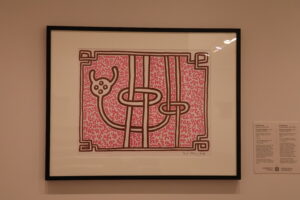
Keith Haring
American, 1958–1990
Chocolate Buddha 3, 1989
Lithograph, edition: 90
Printer: Arts-Litho, Paris, France
Publisher: Editions F. B., Paris, France
Yenna Hill
“I am not a beginning. I am not an end. I am a link in a chain.”
Keith Haring
This print comes from a portfolio that draws inspiration from mandalas, geometric devotional images used in Buddhism and other faiths, as well as Australian Aboriginal paintings. Here, Haring combines the maze-like compositions commonly used in these ancient traditions with his stylized figures to create a design that is both meditative and bold.
Haring wanted everyone to feel welcome to find their own meaning in his art. How would you interpret this print?
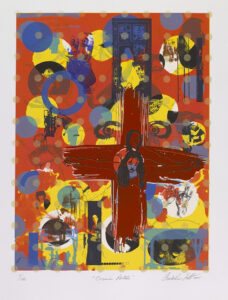
Curlee Raven Holton
American, born 1951
Organic Portals, 2005
Screen print, edition: 100
Printer: the artist
Publisher: Experimental Printmaking Institute, Lafayette College, Easton, PA
Gift of Mr. and Mrs. Arnold Kaplan, 2005. (2005.15)
In this print, Holton explores vibrant color, layered composition, and cross-cultural iconography. The cross at right could easily be interpreted as a religious symbol of the Crucifixion of Christ, but this motif can have alternative meanings across cultures. The artist considers this symbol an intersection of transcendence, a representation of a crossroad where one can pass through realities.
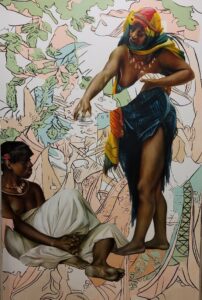
Angela Fraleigh
American, born 1976
And then we’ll walk right up to the sun, 2016
Oil, acrylic, and marker on canvas
Purchase: Priscilla Payne Hurd Endowment Fund, 2019. (2019.11)
The art-historical canon typically portrays women as one-dimensional figures to be lusted after, as victims of violence, or as passive background decoration. Allentown artist Angela Fraleigh retrieves such women from the sidelines of respected historic works, giving them new life in her monumental paintings.
In And then we’ll walk right up to the sun, Fraleigh excerpts figures from two paintings by nineteenth-century French artist Jean-Léon Gérôme, who was known for imagery that affirmed Western fantasies of the Middle East as a place of sensuality, violence, and submissiveness. While Gérôme used these women as foils for white subjects, Fraleigh makes them the focus of her composition. Her work encourages us to explore their agency and possible subversion—with the white protagonists removed from their scene, what might they choose to do?
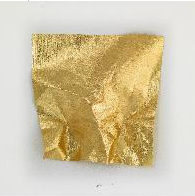
Stephen Antonakos
American, born Greece, 1926‑2013
Terrain #13, 2012
German double deep 22 KT gold leaf on
Tyvek, crumpled
Gift of Naomi S. Antonakos in Memory of Ida Tuttle
Spector, 2023. (2023.21)
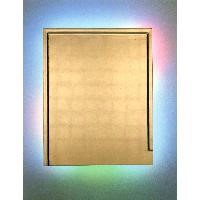
Stephen Antonakos
American, born Greece, 1926–2013
Saint Nicholas, 1989
Gold leaf on wood with neon
Purchase: The Estelle Reninger Fund, 2022. (2022.20)
Pioneering sculptor of light Stephen Antonakos began his innovative work with neon, which he would continue throughout his career, in the early 1960s. The striking lines of brightly colored neon tubes defined space in public art projects and composition in paintings on unstretched canvases. In the early 1980s, when Antonakos began to make panel paintings, he moved the neon behind the form, so that what once was a hard line now became a soft glow, an almost tangible mass upon which the panel floated.
Antonakos’s Saint Nicholas recalls his early years in a small mountain village in Greece, where tiny chapels served people’s religious needs in a hushed candlelit setting. Resembling a Byzantine icon in its wood panel format, use of gold leaf, and reflective glow, the Neon Panel evokes the potential of the spiritual in the abstract.
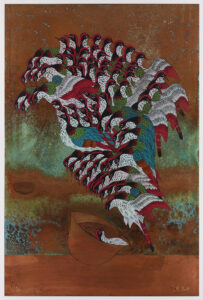
Iman Raad
Iranian, born 1979
Until We Hardly See, 2019
Patinas and screen print on copper, edition: 35
Printers: Pedro Barbeito and Jase Clark, Experimental Printmaking Institute, Easton, PA
Publisher: Experimental Printmaking Institute, Easton, PA
Purchase: Priscilla Payne Hurd Endowment Fund, 2019. (2019.12)
A mirrored bird proliferates like a digital glitch in Until We Hardly See, evoking both seventeenth-century South Asian nature paintings and twenty-first-century technologically mediated visual culture. Iman Raad has explained that these works “mainly evolved after my migration to the United States. Living a hybrid life … I have experienced a stammering communication with, and a shattered understanding of my surroundings, and of myself in the eyes of others.”
Raad’s reality-disrupting subversion of form is supported by his unorthodox application of technique. The copper plate, typically a surface from which to print, is here printed on. The dreamlike setting of the image is the result of chemical modification of the metal surface with experimental homemade patinas of salt, vinegar, and Miracle-Gro®.
