

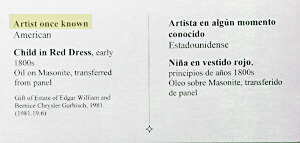
 A designer or artist deeply absorbed in a project in her home or studio—decades or centuries ago—puts the finishing touches on her creation. A group of makers working communally create functional objects of beauty. Today, those works are on view in our galleries. Though these artists’ names have been lost to time, they are identified on the label as “Artist once known.”
“We’ve recently made a change in how we refer to unidentified artists on object labels in the galleries and in our records,” says Elaine Mehalakes, AAM’s Vice President of Curatorial Affairs. “Rather than saying ‘Artist unknown’ or ‘Maker unknown,’ we are now using ‘Artist once known.’ The difference may seem subtle; however, ‘Artist unknown’ suggests that an artist’s identity is unimportant, whereas ‘Artist once known’ implies that a work was made by an individual who was respected and appreciated within their community, even if we can’t identify them today.”
 The shift from “Artist unknown” to “Artist once known” began with cultural institutions such as the Art Gallery of Ontario in Canada adopting this revised language, followed by the Hood Museum at Dartmouth University, the National Gallery of Canada, and Crystal Bridges Museum of American Art, among others. You can now see this phrase used in our American galleries.
 “Museum curators first began using the term ‘Artist once known’ to acknowledge Indigenous makers whose names had not been recorded,” continues Mehalakes. “This dearth of knowledge of Indigenous makers can be attributed to a lack of interest in acknowledging such makers by the dominant society and/or a lack of interest in acknowledging the objects they made as fine art. Some institutions are now using ‘Artist unrecorded’ in place of ‘Artist unknown,’ but I don’t think that language honors the unknown maker in the way that ‘Artist once known’ does. Approximately 20 percent of the objects in our collection—particularly textiles and decorative arts but also Renaissance paintings—will be affected by this change, which also acknowledges many female makers whose names we no longer know.”
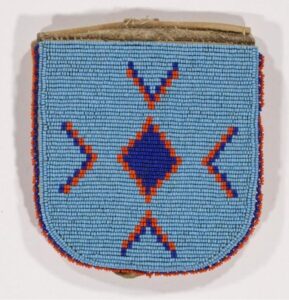
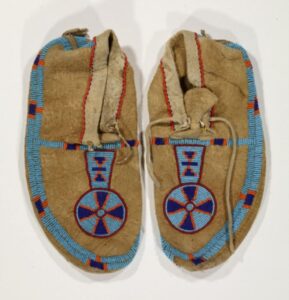
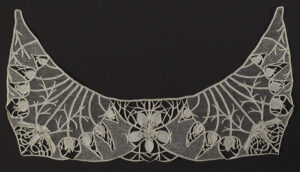 An example is this intricately designed Art Nouveau collar from our collection, seen at left. Other examples include Moccasins and Belt Pouch made by unidentified Nakoda artists around the turn of the twentieth century on view in Butz Gallery, seen above.
The names of some artists may be lost to us, but the history, context, and impact of their works are not. By using “Artist once known,” we are acknowledging our respect for those individuals and their accomplishments.
Seen above:
Artist once known (Nakoda (Stoney/Assiniboine), Moccasins and Belt Pouch, 1885–1920, leather and glass beads, overlay stitch, and Sioux general lane stitched. Allentown Art Museum: Gift of Wendy Ellsworth, 2017. (2017.24.19 and 27 a,b)
Artist once known (Austrian), Collar, ca. 1900, linen needle lace. Allentown Art Museum: Gift of John P. and Elisabeth A. Rappolt, 1977. (1977.41.155.3)