

The Allentown Art Museum is honoring our nation’s 250th anniversary throughout 2026, spotlighting a work from our exhibitions or our collection each month in our weekly eblasts and on our social-media channels. Read these stories of resilience, art, and community below. Beginning June 4, don’t miss the special exhibition Revolution Retold: Commemorating American Independence in Art and Design, exploring different approaches across history to depicting iconic Revolutionary figures and events.
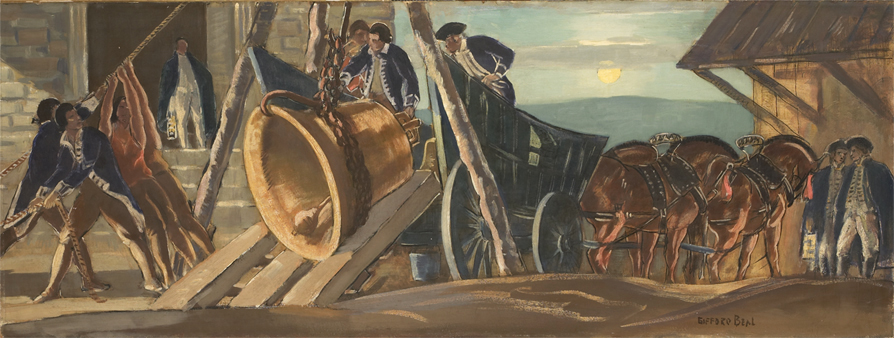
Our first image of the year is this iconic painting that’s on view in our American galleries. Artist Gifford Reynolds Beal captures a powerful moment from local history: cavalrymen bringing the Liberty Bell to Allentown in September 1777. To protect it from being melted down by the British for ammunition, the Bell was one of eleven evacuated from Philadelphia. Beal imagined the dramatic scene as soldiers and townspeople strain together to lift the heavy bell from the wagon before hiding it in the basement of Zion’s Reformed Church on Hamilton Street, just a few blocks from our current location.
This painting was created as a study for one of ten murals commissioned for the Allentown Post Office as part of the Works Progress Administration, a federal program during the Great Depression that supported artists while documenting local history.
Happy George Washington’s birthday! This textile from our collection is part of a series of printed fabrics produced in honor of the bicentennial of George Washington’s birth on February 22, 1732.

H.R. Mallinson & Company, Inc., “Liberty Bell” dress fabric from the George Washington Bicentennial series (detail), 1932, printed silk crepe. Allentown Art Museum: Gift of Kate Fowler Merle Smith, 1978. (1978.26.461)
Rather than depict Washington himself, this textile pairs symbols of the American Revolution—circles of stars, the Liberty Bell—with everyday objects from the colonial past, such as tricorn hats, dishes, and candles.
This combination of motifs reflects the fascination with colonial history and décor during the early decades of the twentieth century. The George Washington Bicentennial Commission capitalized on this interest, encouraging Americans to “become more familiar with the scenes of Colonial days” as well as Washington’s life.
Additional material relating to George Washington’s bicentennial will be on view this summer in our exhibition Revolution Retold: Commemorating American Independence in Art and Design, opening on June 4, 2026.
We continue our celebration of the country’s 250th anniversary by highlighting this work by Ricardo Viera, an artist and curator who made significant contributions to the arts in the Lehigh Valley.
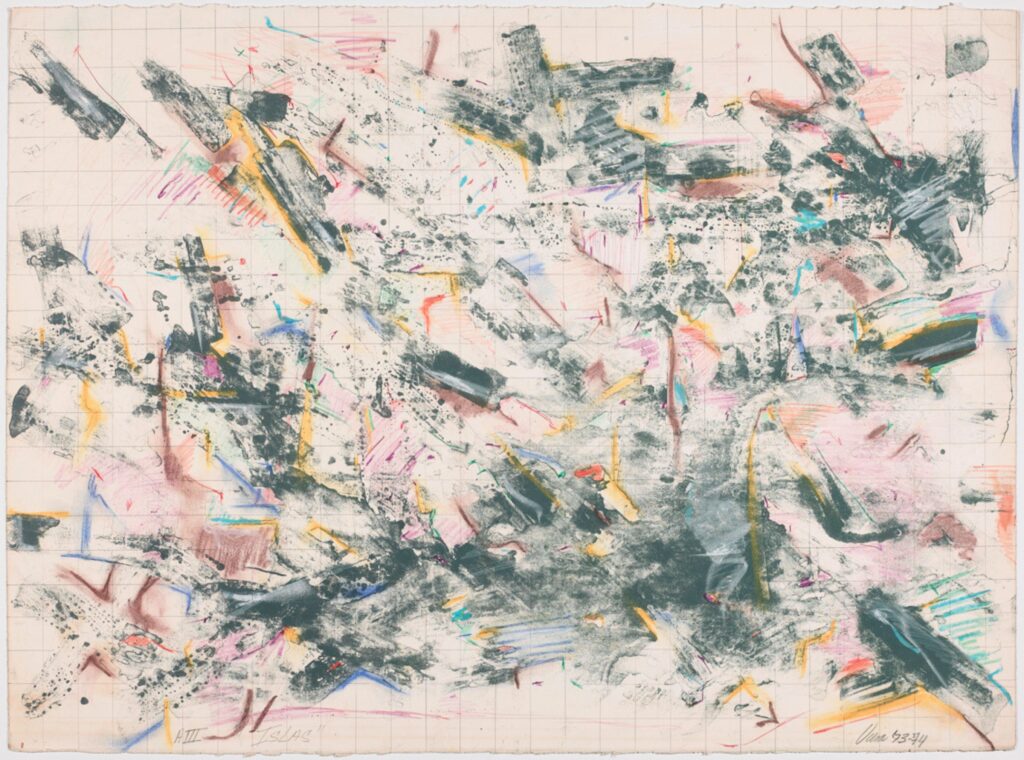
Ricardo Viera (American, born Cuba, 1945–2020), Islas A II, 1973–74, hand-colored lithograph. Allentown Art Museum: Gift of Lucille Bunin Askin, 1976. (1976.37)
Viera immigrated to the United States from Cuba in 1962, an experience that had a profound impact on his artistic practice. He produced several prints on abstract islas (islands) like the one here during the 1970s and 1980s. Bold splashes of color imposed onto a grid recall geographical maps of Cuba. The erratic energy of the lines may embody the artist’s turbulent displacement from his home.
Viera made this print around the time he moved to the Lehigh Valley, where he served as director of the Lehigh University Art Gallery from 1974 through 2018. It entered the Museum’s collection just a few years later, during the last major U.S. anniversary celebration year, the 1976 bicentennial.
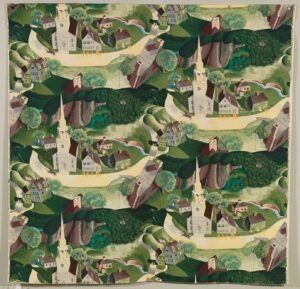
Grant Wood (American, 1891 1942), The Ride of Paul Revere from the series Pioneer Pathways, 1952, printed cotton. Allentown Art Museum: transferred from American Textile History Museum, gift of Cora Ginsburg, 2017. (2017.6.55)
This month, we are featuring a furnishing fabric inspired by an iconic moment in American history—Paul Revere’s ride from Boston to Lexington on April 18th, 1775.
In this textile, Revere is dwarfed by the surrounding landscape! Look for him galloping past the church, while small figures emerge from nearby buildings to hear his warning about the impending British invasion.
Grant Wood based this textile design on his 1931 painting, The Midnight Ride of Paul Revere. While the painting depicted Revere riding at night, here the scene is brightly lit, perhaps to offer a color palette that was more appealing for home decor.
 This month, join AAM Associate Curator Claire McRee for a hunt through our American galleries to discover eagle motifs in the Museum’s textile collection.
The eagle was a popular emblem for home decor in the nineteenth century and beyond, as demonstrated by the varied and creative interpretations pictured here. Many of these textiles drew inspiration from the Great Seal of the United States, which depicts an eagle overlaid with a shield, holding arrows and an olive branch in its talons.
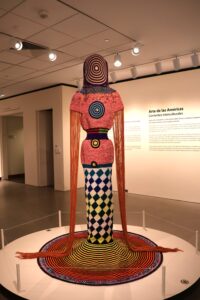
Xenobia Bailey (American, born 1955), “Sistah Paradise and the Egungun” from the series “Paradise Under Reconstruction in the Aesthetic of Funk – Phase II”, 1999, tapestry crochet, acrylic and cotton yarn, wire, beads. Allentown Art Museum: purchase, the Reverend and Mrs. Van S. Merle‑Smith, Jr. Endowment Fund, 2000. (2000.17.1)
This month, in honor of Juneteenth, we are featuring the work of Xenobia Bailey. Her fiber sculpture Sistah Paradise and the Egungun, currently on view in our American galleries, comes from a series of works that subvert histories of enslavement and oppression through alternative, empowering narratives.
The feminine form of this sculpture is based on Sistah Paradise, a fictional mystic who used her magical abilities to free enslaved Africans. She would spin mystical thread from plantation cotton and crochet an elaborate tent, where enslaved people could drink from her tea set and be transported back to Africa. Bailey also includes bright color, mixed patterns, and concentric circles to reference the Egungun, ancestor spirits manifested through clothing who bestow blessings and protection on their lineage during annual festivals in Yoruba communities.
Bailey sees her sculptures as meditative tools for addressing generational trauma stemming from enslavement and the forced assimilation policies that followed the American Civil War. Bailey references this repressive period, known as Reconstruction (1863–1877), in the title of this series, Paradise Under Reconstruction in the Aesthetic of Funk.
Come experience this monumental work through August 30.
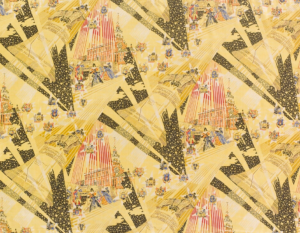
Walter Mitschke (American, b. Germany, 1886–1972), “Betsy Ross / Liberty Bell” dress fabric, from the “Early American” series, 1929, printed silk plain weave. Manufacturer: H. R. Mallinson & Company, Inc. Allentown Art Museum: Gift of Kate Fowler Merle‑Smith, 1978. (1978.26.707)
Happy Independence Day! This dress fabric from 1929 celebrates the American Revolution through modern design. Its radiating lines create a sense of movement, drawing our eyes to the Liberty Bell and Betsy Ross, who is showing off her flag to Washington. In the background the flag theme continues with stars and stripes as well as scattered white stars that frame the state crests of the thirteen colonies. Visit our current exhibition Revolution Retold to learn more about this work and others like it.
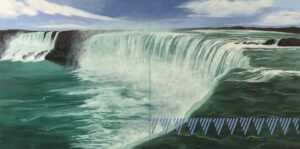
Kay WalkingStick (Cherokee, born 1935), Niagara, 2022, oil on panel in two parts. The New York Historical, Purchased through the generosity of Agnes Hsu-Tang and Oscar Tang; Nancy Newcomb; Anonymous; Barry Barnett; Helen Appel; Belinda and Charles Bralver; Dorothy Tapper Goldman; Margi and Andrew Hofer; Louise Mirrer; Jennifer and John Monsky; Suzanne Peck and Brian Friedman; Pam and Scott Schafler; Barbara and Elliott Wagner; and Linda Ferber, 2023.2ab. © Kay WalkingStick
This painting both revels in and reclaims Niagara Falls. Cherokee artist Kay WalkingStick captures their sublime sweep by suspending the viewer at the brink and spilling the water edge-to-edge across two square panels. A Haudenosaunee pattern overlaid on the composition honors those who originally inhabited, and still inhabit, the Niagara region. Suspended over the landscape as if to safeguard it, the stenciled band reclaims a site long cast by white artists as “American”—a place of New World beauty capable of rivaling the monuments of Europe—as Indigenous.
Explore more of WalkingStick’s work in the exhibition Kay WalkingStick / Hudson River School, on view through October 11.
This exhibition has been organized by The New York Historical.
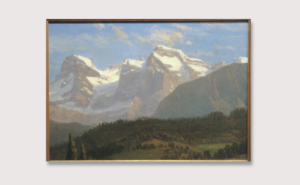
Albert Bierstadt (American, 1830–1902), “Snow Covered Peaks,” ca. 1859, oil on paper mounted on board. Allentown Art Museum: purchase, The Reverend and Mrs. Van S. Merle‑Smith, Jr. Endowment Fund, 1983. (1983.7.2)
This month we’re highlighting a work from our collection, “Snow Covered Peaks” by Albert Bierstadt. This oil sketch dates to the first of Bierstadt’s three western voyages, when he accompanied Frederick W. Lander’s government-sponsored survey to the Rockies in 1859. The surveyors sought a new wagon route that avoided areas of conflict between Native nations and Anglo-American settlers. Bierstadt erased the political nature of their survey from his study, depicting only an open mountain range and tranquil woodlands.
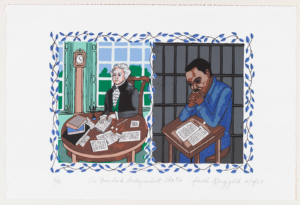
Faith Ringgold (American, 1930–2024), “As Free and Independent States” from the series “The Declaration of Freedom and Independence,” 2009, screen print. Allentown Art Museum: purchase, The Ardath Rodale Art Acquisition Fund, 2015. (2015.8.12)
In this print, Faith Ringgold creates a stark contrast between the comfortable workspace where Thomas Jefferson drafted the Declaration of Independence and the dark cell from which Dr. Martin Luther King Jr. wrote his “Letter from a Birmingham Jail.” Much like the Declaration, King’s letter emphasizes the need to respond to injustice with timely action; it became a foundational text of the Civil Rights Movement.