

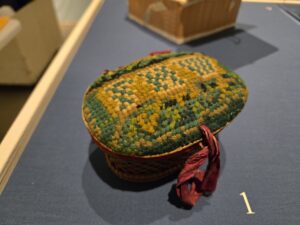
1 Artist once known
American
Sewing Basket, 1874
Reed, wool needlepoint on punctured paper, cotton lining, silk ties
Gift of Pamela Miller Ness and Paul Marc Ness in Memory of Professor and Mrs. Edwin Haviland Miller, 2003 (2003.39.372)
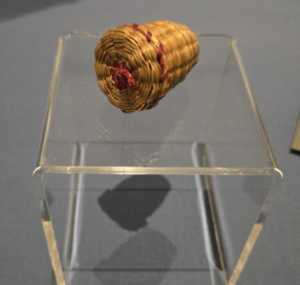
2 Artist once known
American
Thimble Case, early twentieth century
Sweet grass
Gift of Mrs. William P. Hacker, 1997. (1997.31.423)
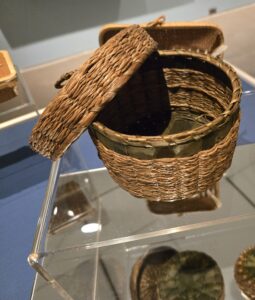
3 Artist once known
Wabanaki (Eastern Woodlands)
Basket, late nineteenth century
Sweet grass, ash splint
Gift of Pamela Miller Ness and Paul Marc Ness in Memory of Professor and Mrs. Edwin Haviland Miller, 2003 (2003.39.381)
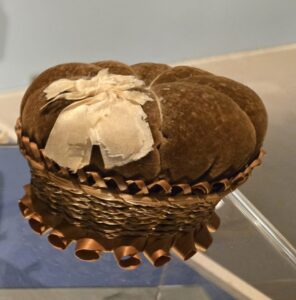
4 Artist once known
Wabanaki (Eastern Woodlands)
Basket with Pincushion, late nineteenth century
Braided sweet grass, ash splint, velvet, silk ties
Gift of Pamela Miller Ness and Paul Marc Ness in Memory of Professor and Mrs. Edwin Haviland Miller, 2003
(2003.39.382)
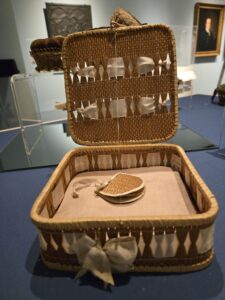
5 Artist once known
Canterbury Shakers, New Hampshire
Sewing Basket with needle book, late nineteenth or early twentieth century
Poplar cloth, satin lining, silk ties
Gift of Pamela Miller Ness and Paul Marc Ness in Memory of Professor and Mrs. Edwin Haviland Miller, 2003
(2003.39.376)
6 Artist once known
Alfred Shaker Village, Maine
Basket, late nineteenth or early twentieth century
Poplar cloth, silk lining, silk ties
Gift of Pamela Miller Ness and Paul Marc Ness in Memory of Professor and Mrs. Edwin Haviland Miller, 2003
(2003.39.371)
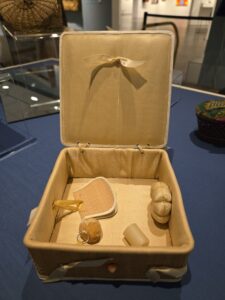
7 Artist once known
Sabbathday Lake Shaker, Maine
Sewing Basket with pincushion, needle book, wax, and needle sharpener, late nineteenth or early twentieth century
Poplar cloth, satin lining, kid leather, satin ties
Gift of Pamela Miller Ness and Paul Marc Ness in Memory of Professor and Mrs. Edwin Haviland Miller, 2003 (2003.39.377)
The woven baskets seen here provide a glimpse into the concurrent basketry traditions in the Northeast United States during the nineteenth and early-twentieth century. Representing both Euro-American and Wabanaki Nation artists, this selection illustrates the differences and similarities in woven baskets across cultures.
The Wabanaki baskets (3 and 4) transformed traditional materials (sweet grass and ash splint) and designs to create commercial goods for a growing trade market. Using olive green and brown dyes to fit prevailing Victorian tastes, these innovative artists adapted their colorways to best market their baskets for Euro-American audiences.
The Shakers– a religious community based in the Northeast United States– also produced woven baskets (5, 6, and 7) as a vital source of income for their community. Driven by the region’s rise in tourism and the looming threat of industrialization in the mid-nineteenth century, Sisters of the Shakers produced handcraft household goods using primarily poplar cloth, silk, leather, and wool.
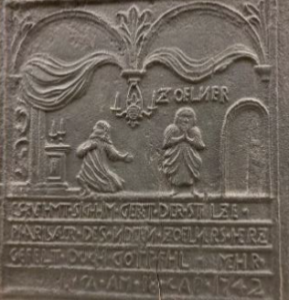
Artist once known
American
Stove Plate: Publican and Pharisee, 1742
Cast iron
Made in Pennsylvania
Inscription: “The proud Pharisee glorifies himself in prayer, but the heart of the humble Publican pleases God much better. Luke Chapter 18, 1742”
Gift of Dorothy C. Miller, 1975. (1975.148)
In the Christian parable of the Pharisee and the Publican, Jesus teaches humility by recognizing the ardent Publican, a Jewish tax collector for the ancient Romans, over the self-righteous Pharisee, a member of an ancient Jewish sect who believed their manner of religious observance superior. The designer of this stove plate based its design on an illustration from a popular German bible (below).
This work not only reflects the transfer of German traditions to Pennsylvania, but also calls to mind iron foundries’ as enslavers. Enslaved people, some of whom may have had experience in West African metalworking techniques, often performed skilled work at mid-Atlantic foundries.
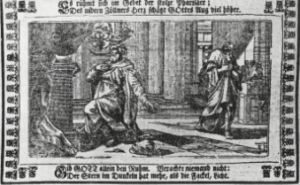
Illustration from the Elector Bible (published in 14 editions, 1640–1758). Pictured in Henry Mercer, The Bible in Iron (Doylestown: Bucks County Historical Society, 1961), 191.
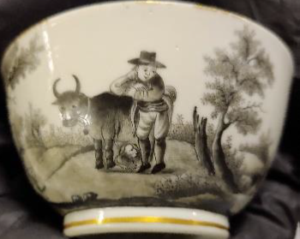
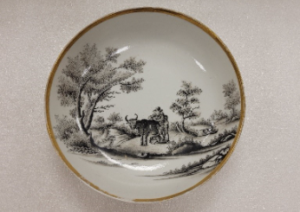
Artist once known
Chinese
Cup and Saucer, ca. 1805
Porcelain with black enamel overlay and gilding
Made in Jingdezhen, China, for export to American market
Gift of Hampton C. Randolph Sr., 1984. (1984.23.1, 2)
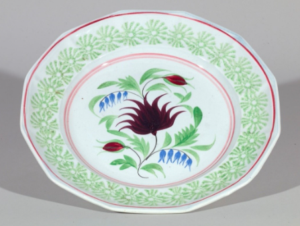
Artist once known
British
Plate, 1835–1855
Ceramic (spatterware)
Made in Britain for export to Pennsylvania German market
Gift of Mr. and Mrs. Arnold Kaplan, 2009. (2009.28.15)
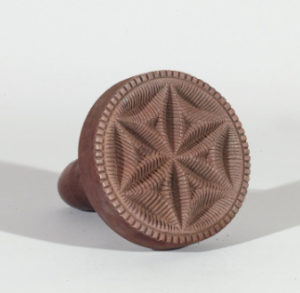
Artist once known
American
Buttermold, 1800s
Poplar
Made in Pennsylvania
Gift of William W. Swallow, 1963.
(1963.152a, b, c)
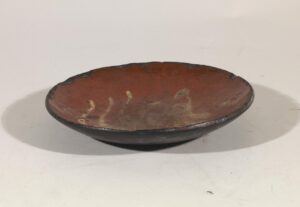
Artist once known
American
Plate, 1800s
Redware
Made in Pennsylvania
Gift of Mr. and Mrs. Herman E. Finkelstein, 1975. (1975.110)
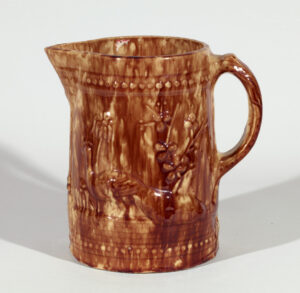
Artist once known
American
Pitcher, 1800s
Ceramic
Gift of Mr. and Mrs. Herman E. Finkelstein, 1975. (1975.122)
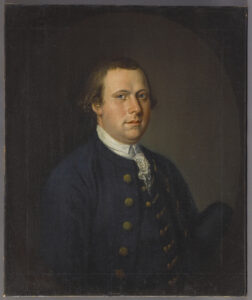
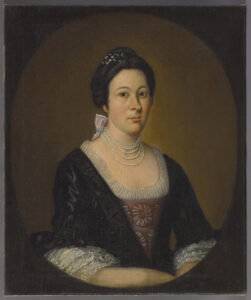
James Claypoole Jr.
American, ca. 1743–1822
Robert Shewell, 1765
Sarah Sallows Shewell, 1765
Oil on canvas
Made in Philadelphia, PA
Purchase: Priscilla Payne Hurd Endowment Fund, and Gift of Francie Starr, 1992. (1992.19.1, 2)
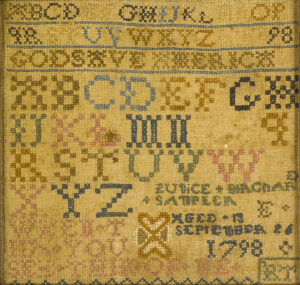
Eunice Birchard
American, ca. 1785–1859
Sampler: “God Save America,” 1798
Linen plain weave with silk cross‑stitch embroidery
Probably made in Norwich, CT
Gift of Mrs. William P. Hacker, 1979. (1979.80.46)
Inscriptions: God save America; When this you see, think of me
While samplers sometimes include moralizing or religious texts, Eunice Birchard’s boldly proclaims, “God Save America.” During the Revolution, American colonists appropriated Britain’s “God Save the King,” transforming this statement of allegiance into a call for independence. When thirteen-year-old Eunice stitched her sampler two decades later, “God Save America” remained a popular song, but an unexpected text for schoolgirl needlework. Eunice (or her teacher) may have been looking at older samplers from their community for inspiration: a 1776 sampler from Norwich, Connecticut also features this patriotic sentiment.
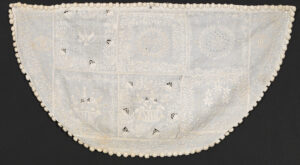
H.H.
Table Cover, 1800–1830
Cotton with satin stitch, French knot, bullion, buttonhole, feather stitch, and backstitch embroidery
Gift from the Collection of Rosalind and Edwin Miller, 2000. (2000.27.13)
Artist once known
French
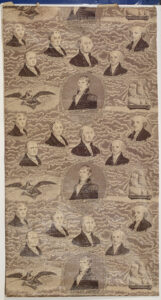
Furnishing Fabric, ca. 1830
Printed cotton plain weave, glazed
Made in Mulhouse, France, for the American market
Gift of Kate Fowler Merle‑Smith, 1978.
(1978.26.486)
This textile commemorates the first seven presidents of the United States, giving special attention to the current president, Andrew Jackson. Celebrated as the hero of the War of 1812, Jackson is depicted in military uniform, alongside the warship the USS Constitution, another veteran of the conflict.
Printed in France using engraved copper rollers, this finely detailed fabric would have been a luxury for American consumers. Nonetheless, it found an eager audience—it survives in fragments like ours, as well as quilts, and was popular enough to be issued in multiple colorways, including red, blue, and green.
Artist once known
American
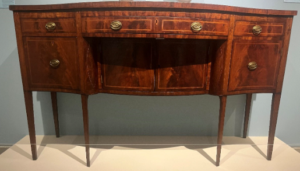
Sideboard, ca. 1795
Mahogany veneer with satinwood inlay
Made in Philadelphia, PA
Gift of Estate of Robert C. Alexander, 1988.
(1988.14.3)
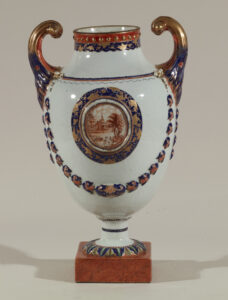
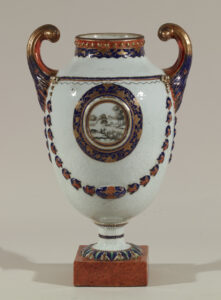
Artist once known
Chinese
Urns, ca. 1790
Porcelain with enamel overglaze decoration
Made in China for export to Western market
Gift of Mrs. William P. Hacker, 1981.
(1981.25.1, 2a, b)
The unique shape and delicate decoration of these urns illustrate Chinese artists’ skill in producing porcelain for a Western audience. Using prints and painted wooden models provided by European merchants, Chinese artists created export goods that suited current fashions halfway around the world. On these urns, details like floral swags and faux-woodgrain bases cater to the taste for designs inspired by ancient Greece and Rome.
The United States became a leading importer of Chinese porcelain soon after independence.
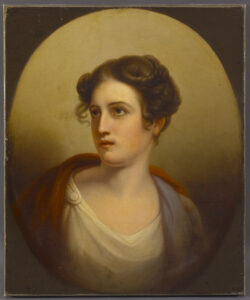
Rembrandt Peale
American, 1778–1860
Erinna, ca. 1830s
Oil on canvas
Made in Philadelphia, PA
Purchase: General Acquisitions Fund; the Gift of Paul Kania; and the Gift of Sam and Missy Saxton, 2002. (2002.22)
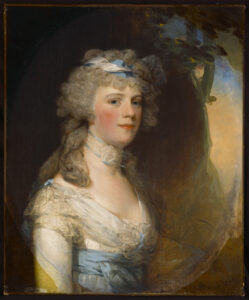
Gilbert Stuart
American, 1755–1828
Ann Penn Allen, ca. 1795
Oil on canvas
Made in Philadelphia, PA
Purchase: The Gift of John and Fannie Saeger, 1978. (1978.13)
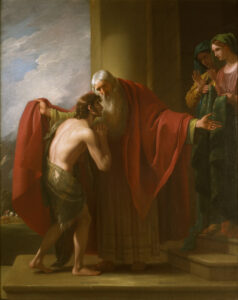
Benjamin West
American, 1738–1820, active in Britain
Return of the Prodigal Son, 1772
Oil on canvas
Made in London
Purchase: Priscilla Payne Hurd Endowment Fund, 2002. (2002.19)
The dramatic light and expressive poses of father and son in this work by Benjamin West contrast with Haidt’s painting at right. West actually took lessons from Haidt as a teen, and his earlier work resembled Haidt’s style. After study in Italy, however, he mastered the realism and subtlety of academic painting, and settled in London where he met great success.
A generation of American artists would travel to London to train with West—including Gilbert Stuart and Rembrandt Peale, whose works are at left.
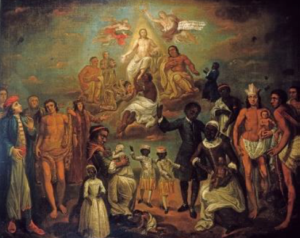
John Valentine Haidt
American, born Germany, 1700–1780
Erstlingsbild (“First Fruits”), ca. 1754–1760
Oil on canvas
Made in Bethlehem, PA
Loan from the Moravian Archives
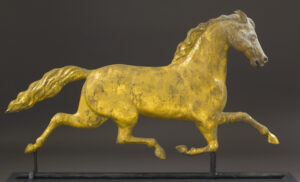
American
Trotting Horse, mid- to late 1800s
Hammered copper, tin wash and gold leaf
Purchase: The Gift of John and Fannie Saeger, 1973. (1973.3)
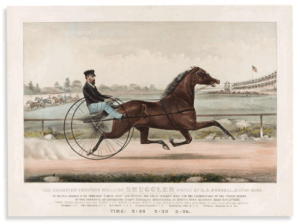
Currier & Ives
The Champion Trotting Stallion Smuggler, 1875,
hand-colored lithograph.
Image courtesy of Swann Auction Galleries.
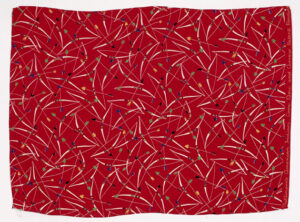
H.R. Mallinson & Company, Inc.
American textile manufacturer, 1915–1937
Crow Bow and Arrow dress fabric from the American
Indian Series, 1937
Printed silk
Gift of Kate Fowler Merle‑Smith, 1978. (1978.26.611)
In the 1920s and 1930s, H. R. Mallinson & Company produced several dress fabric lines inspired by Native American and colonial imagery driven by consumer interest in such subjects. Here, designers combined motifs they associated with Plains cultures with bold colors and a modern, all-over design. Manufactured by an Anglo-American fabric company, the designs in this series provided an interpretation of Indigenous identity constructed from prevailing stereotypes of these cultures.
This dress fabric is the type of generalized representation of Apsáalooke identity that Wendy Red Star, at right, pushes against in her contemporary photography series.
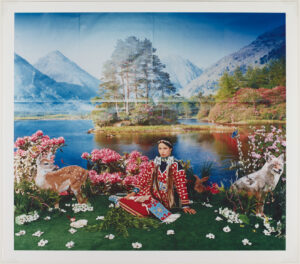
Wendy Red Star
Apsáalooke, born 1981
Spring from The Four Seasons Series, 2006
Archival pigment print
Purchase: Priscilla Payne Hurd Endowment Fund, 2019. (2019.2.2)
“People will often ask me why I choose humor for sensitive topics, such as the portrayal of Native people in popular culture. Humor is healing, healing is power, and power overcomes obstacles.”
—Wendy Red Star
By posing in her traditional Apsáalooke (Crow) regalia in a fake “natural” environment, artist Wendy Red Star recalls spaces in which Native Americans have been subject to one-dimensional portrayals—such as natural history museum dioramas or Hollywood sets. She cleverly undermines the assumption that Native Americans share a special connection with nature, and asks us to consider how stereotypes shape the perception of Indigenous people today.
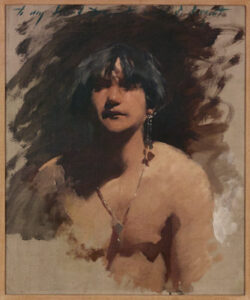
John Singer Sargent
American, 1856–1925, active in Europe
Head of a Young Woman,
1878–1880
Oil on canvas
Gift of Katherine Merle‑Smith Thomas, 2008.
(2008.22)
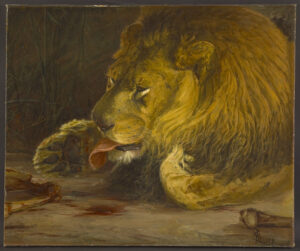
Henry Ossawa Tanner
American, 1859–1937, active in France
Lion Licking Paw, 1886
Oil on canvas
Made in Philadelphia, PA
Gift of Mr. and Mrs. Philip I. Berman, 1962. (1962.5)
Henry Ossawa Tanner painted this lion from life at the Philadelphia Zoo. He was preparing to make a larger work depicting Androcles, a formerly enslaved Roman who stopped to remove a thorn from a lion’s paw while fleeing his enslavers.
Tanner often explored stories of oppression and freedom in his work. As the son of a woman who liberated herself from slavery, and as an expatriate who left the United States to mitigate racism’s impact on his career, he likely found particular significance in these themes.
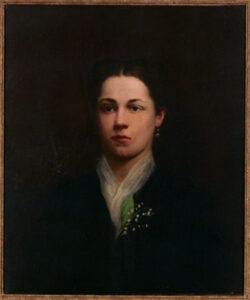
Susan Macdowell Eakins
American, 1852–1938
Kate Lewis, 1884
Oil on canvas
Made in Philadelphia, PA
Purchase: J. I. and Anna Rodale Fund, 1945. (1961.21)
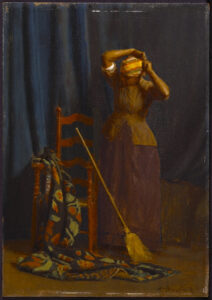
Thomas Pollock Anshutz
American, 1851–1912
The Chore, ca. 1888
Oil on wood panel
Made in Philadelphia, PA
Purchase: J. I. and Anna Rodale Fund, 1949.(1961.26)
What might the woman who posed for this painting have thought about the finished work? Artist Thomas Anshutz—who was white—hired her to model because he wanted to paint a Black female servant, and chose the studio props, her pose, and the scarf she wears.
Either she or someone close to her probably had experience working as a servant: an 1899 study by W.E.B. DuBois and Isabel Eaton found that 90% of Black women employed in Philadelphia at this time were in domestic service. Maybe this woman preferred modeling to her regular job—or perhaps it was more tiring to work with Anshutz.
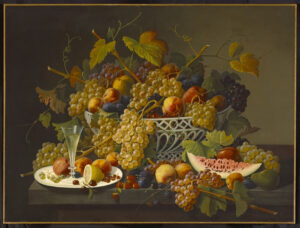
Severin Roesen
German, ca. 1815–ca. 1872, active in the United States
Still Life with Wine Glass and Watermelon, ca. 1860
Oil on canvas
Purchase: Frank E. and Seba B. Payne Foundation Gift, 1987. (1987.41)
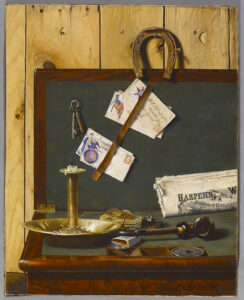
George Cope
American, 1855–1929
Mr. Darlington’s Still Life, 1890
Oil on canvas
Made in West Chester, PA
Purchase: Leigh Schadt and Edwin Schadt Art Museum Trust Fund, 2004. (2004.35)
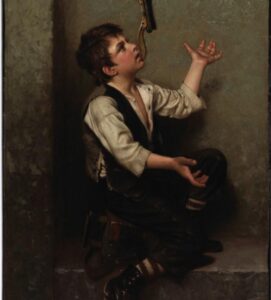
John George Brown
American, born England, 1831–1913
Juggler, 1882
Oil on canvas
Purchase: Leigh Schadt and Edwin Schadt Art Museum Trust Fund, 2013. (2013.1)
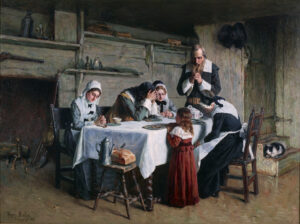
Henry Mosler
American, 1841–1920
Invoking God’s Blessing (Pilgrim’s Grace), 1897
Oil on canvas
Gift of Mr. and Mrs. Norman Hirschl, 1977. (1977.4)
In their humble home, this Pilgrim family embodies faith, morality, and simplicity—values that some Americans feared were disappearing in the late 1800s. Artists like Henry Mosler depicted the past to offer inspiration and reassurance to those worried about urbanization and immigration transforming the United States.
Such artists were usually more concerned with celebrating American identity than with historical accuracy. Look for fun anachronisms in this painting, such as the very Victorian bows, and painted Chinese porcelain (rare in North America until about a century after the Pilgrims’ time).
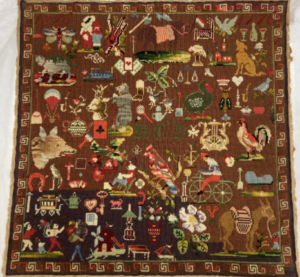
R. C. D.
American
Sampler, 1876
Wool and silk tent stitch embroidery on canvas
Gift of Mr. and Mrs. Arnold Kaplan, 2009. (2009.6.1)
While earlier generations prioritized order and refinement in their needlework, by the 1870s women embraced a “more is more” aesthetic. The maker of this sampler, R.C.D., included a variety of imagery, from dodos to hot air balloons. She also stitched the dates 1876 and 1776, in commemoration of the nation’s Centennial. R.C.D. likely collected the patterns for this project from magazines, which often published charts for small needlepoint motifs.
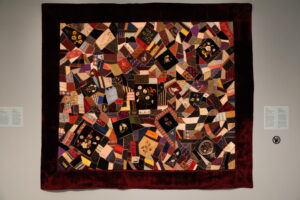
M.A. E.
Crazy Quilt, 1888
Pieced silk with silk, chenille, and ribbon embroidery
Transferred from American Textile History Museum, Gift of Nancy Brigham, 2017. (2017.6.11)
Like the sampler at left, this quilt reflects an interest in collecting and assembling a wide array of material. The quilt’s maker, M.A.E., enhanced its eclecticism by adding embroidery in varied textures, making use of gleaming silk floss, ridged grosgrain ribbon, and fuzzy chenille yarn.
Such quilts made of irregular pieces, called crazy quilts, could act as a sort of scrapbook of personal and found textiles. M.A.E. stitched “1790” on a strip of red and blue plaid silk, near the central square—perhaps this piece came from a garment passed down in her family.
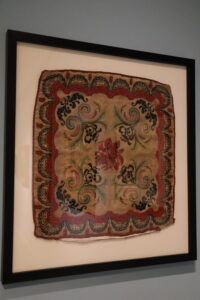
Mary Hollingsworth Carson
American 1813–1868
Pillow Cover, ca. 1850s–1860s
Linen plain weave with wool and silk
tent stitch embroidery, brass and jet
beadwork, and silk‑wrapped linen cord
Gift of Mrs. William P. Hacker, 1982. (1982.4.1)
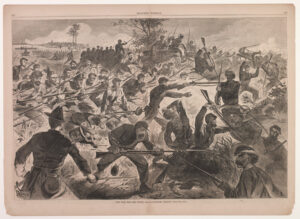
Winslow Homer
American, 1836–1910
The War for the Union, 1862 – A Bayonet Charge from
Harper’s Weekly, July 12, 1862
Wood engraving
Printer and publisher: Harper & Brothers, New York, NY
Purchase: SOTA Print Fund, 2006. (2006.15.3)
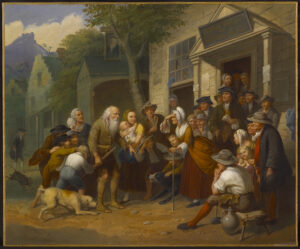
Tompkins Harrison Matteson
American, 1813–1884
The Return of Rip Van Winkle, or, Rip Van Winkle’s Return from the Mountains,
1840–1845
Oil on canvas
Purchase: The Leigh Schadt and Edwin Schadt Art Museum Trust, 2001. (2001.10)
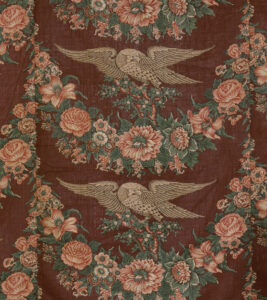
Artist once known
English
Furnishing Fabric, ca. 1825–1835
Roller and block-printed glazed cotton
Purchase: The Reverend and Mrs. Van S. Merle-Smith, Jr. Endowment Fund, 2008. (2008.8)
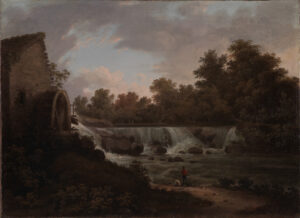
Thomas Birch
American, 1779–1851
Great Falls of the Lehigh at Stoddartsville, Pennsylvania, late 1820s–1830s
Oil on canvas
Purchase: Gift from Three Supporters in Honor of Elliot J. Sussman’s Years of Service to the Allentown Art Museum and the Priscilla Payne Hurd Endowment Fund, 2011. (2011.18)

American
Stag, 1800s
Oil on barrel top
Made in Pennsylvania
Inscription: “You beautiful deer, don’t run so proudly, the hunter stands behind the woods”
Gift of Estate of Edgar William and Bernice Chrysler Garbisch, 1981. (1981.19.8)
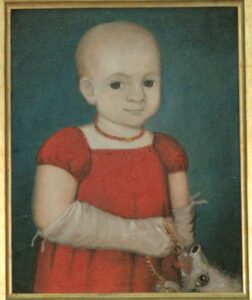
Artist once known
American
Girl in Red Dress, early 1800s
Oil on Masonite, transferred from panel
Gift of Estate of Edgar William and Bernice Chrysler Garbisch, 1981. (1981.19.6)
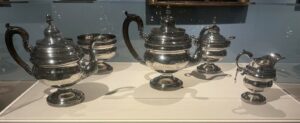
William Seal
American, active 1810–1822
Coffee Pot, Creamer, Teapot, Sugar Bowl, Waste Bowl, Tongs, ca. 1817
Silver
Made in Philadelphia, PA
Anonymous Loan
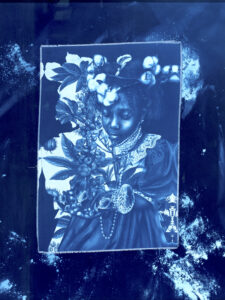
Tokie Rome-Taylor
American, born 1977
Caste or Seed Variegated Blue from the series Rooted in Seeds of Memory, 2024
Cyanotype on cotton sateen, muslin, thread
The Petrucci Family Foundation Collection of African American Art
In this photograph, a girl gazes at her cupped hands, where a plant grows. This work comes from a series by Tokie Rome-Taylor, which honors the botanical knowledge that enslaved Africans brought with them to the Americas. Such knowledge contributed to enslaved people’s survival, enabling them to grow or forage their own food, and tend to medicinal and spiritual needs.
Rome-Taylor describes her art as “photographic seedlings,” which “[grow] new folklore” to counteract history’s frequent erasure of Black agency.
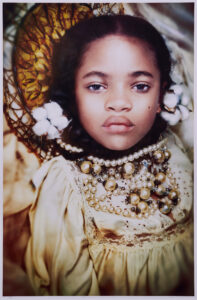
Tokie Rome-Taylor
American, born 1977
Our Value > Cotton and Gold, 2020
Archival pigment print, ed. 10
The Petrucci Family Foundation Collection of African American Art
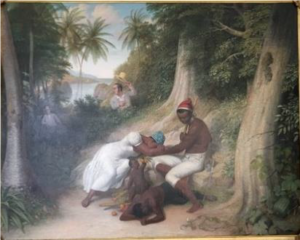
British or French
Cimarrónes or Quilombolas Fleeing Enslavement, ca. 1820s
Oil on canvas
Gift of John (Jay) and Jan Ruhle, 2022. (2022.14)
This painting depicts an enslaved family seeking freedom. Based on the topography and tropical setting, they are likely cimarrónes or quilombolas—people who liberated themselves from enslavement and established free communities in the Spanish Caribbean and Brazil. The sticks of sugarcane on the ground and in the man’s hand suggest that he was forced to labor to produce sugar, a commodity in demand around the world.
Explicit in its detail of the man’s shackles and the distress of the woman and older son, the image was likely meant to inspire sympathy in support of the abolitionist cause to end slavery. The man’s red cap is a symbol of liberty, worn in Roman times by formerly enslaved people who had gained their freedom.
This composition echoes Christian scenes of the Rest on the Flight into Egypt, in which the Holy Family paused during their escape to save the life of the infant Jesus. As the family in the painting here faces the threat of recapture, the young child at the center seems to offer a bit of hope.