American, born Germany, 1917–1992
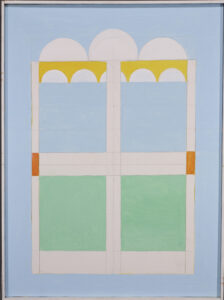
N.Y. VII, 1972
Acrylic on canvas
Gift of the Artist in Memory of David Getz, 1975. (1975.162.3)
Aliza Nisenbaum
American, born Mexico, 1977
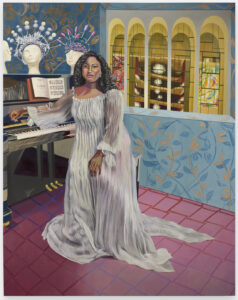
15 Minutes to Curtain, Soprano Angel
Blue (MET Traviata), 2023
Oil on linen
Partial gift of Eric Emmanuel with additional funding provided by The Estelle Reninger Fund, 2024. (2024.7)
This painting is one of three diva portraits that Aliza Nisenbaum created of the sopranos in the Metropolitan Opera’s 2023 rendition of La Traviata. In this project, she was interested in the stars behind the opera’s glamorous production. Here, one of the lead performers, Angel Blue, stands in her dressing room beside her sheet music and piano complete in her makeup and costume. Nisenbaum’s use of shimmering gold and silver, pastel colors, and decorative patterns create a fairytale atmosphere, emphasizing the magical quality of stage production. Her emphasis on Blue behind-the-scenes underscores the creative labor that often goes unseen in theater and opera.
George Segal
American, 1924–2000
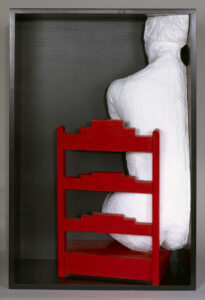
Girl on a Chair, 1970
Plaster, wood and polyurethane paint, edition: 150
Published by Editions Alecto Ltd., London, England
Gift of Mr. Richard Roth, 1978. (1978.48)
Rigo Peralta
American, born Dominican Republic, 1970
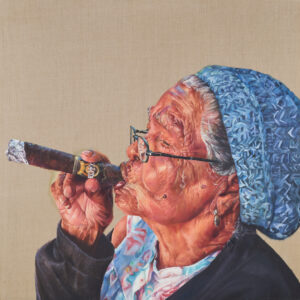
Doña Negra, 2016
Acrylic on linen
Purchase: The Ardath Rodale Art Acquisition Fund, 2019. (2019.7)
This portrait of the artist’s grandmother upends the expected formality of the format and brings its sitter to vibrant life. Analuisa Torres-Peralta was affectionately known as La Negra for her dark skin. In this painting, Doña Negra—at age 94—smokes an Exactus Maduro cigar, made in the Dominican Republic where both she and her grandson were born. The cigar recalls the long history of tobacco growing in the Dominican Republic. It suggests the country’s role in the global economy and references the Indigenous Taino people who cultivated tobacco in the Caribbean islands. The portrait also evokes fond and important memories for the Allentown-based artist, who has said, “It represented an almost sacred ritual to be able to smoke a Dominican cigar with my grandmother.”
Nelson Shanks
American, 1937–2015
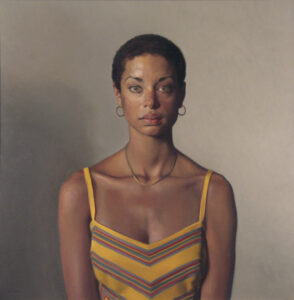
Nancy, 1974
Oil on canvas
Gift of Mr. and Mrs. Franklin D. Crawford, Princeton, New Jersey, 1975. (1975.147)
The founder of a school for realist art in Philadelphia, Nelson Shanks is known for his presidential portraits, including those of Ronald Reagan and Bill Clinton, and his portraits of influential women, such as the first four female justices of the U.S. Supreme Court. Here Shanks lends gravitas to a more personal depiction of an individual woman.
Chris Martin
American painter, born 1954
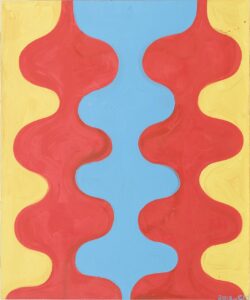
Like Seven Inches from the Noonday Sun, 2013
Oil on canvas
Gift of the Weissman Family Collection, 2023. (2023.26)
 Artist once known
Guna
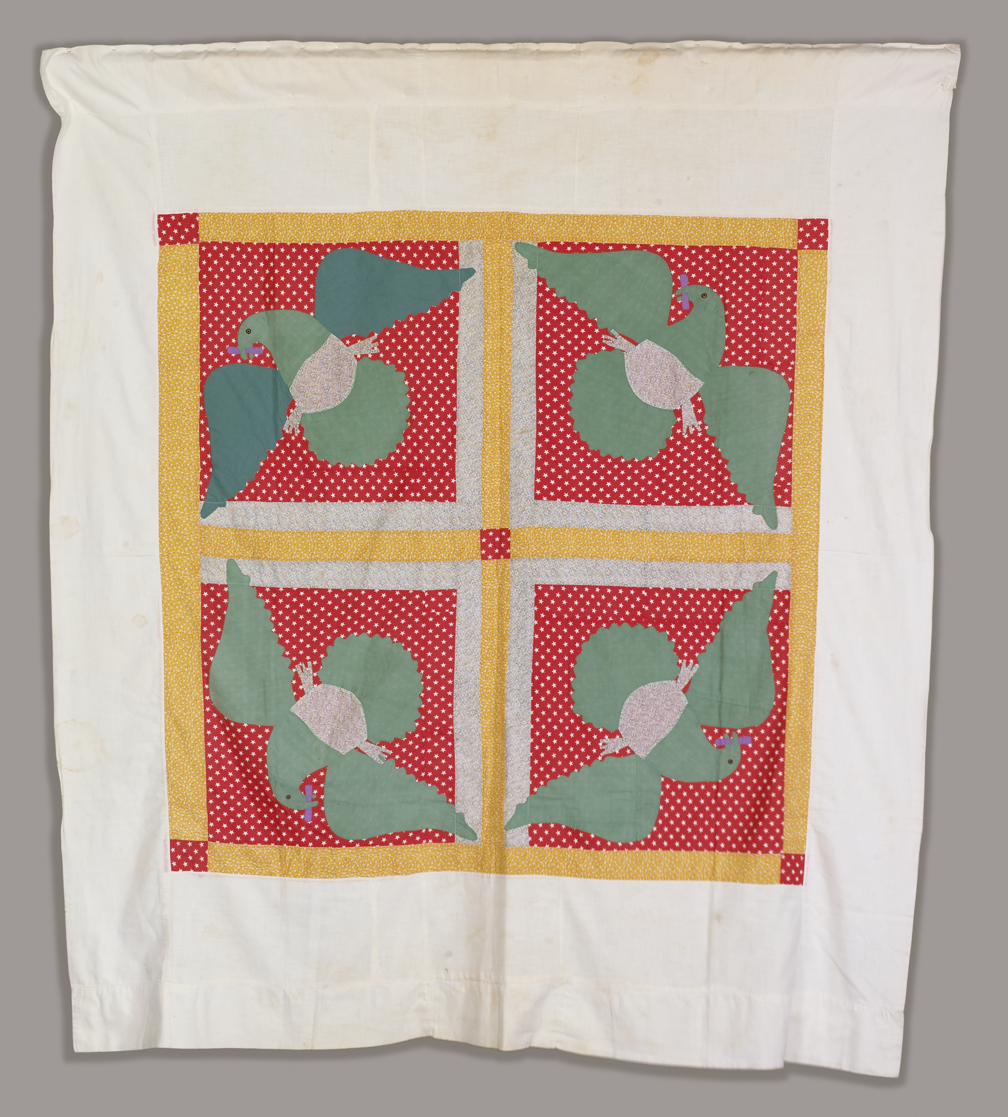
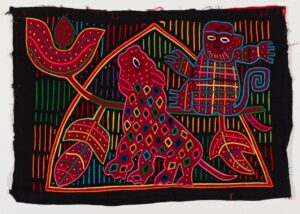
Mola, 1970s–1980s
Cotton with appliqué, reverse appliqué, and chain stitch embroidery
Collection of Al and Eadie Shanker, 2019. (2019.27.42)
Guna women make these vibrant textiles, called molas, to use as the front and back panels of a traditional blouse.
The Guna have developed a distinct artistic style that prioritizes bright colors, all-over pattern, and precise cutting and sewing.
In 1918, Panama’s government tried to bring the Guna under their control and outlawed important customs such as wearing molas. The Guna revolted and kept their sovereignty, and today, molas remain a key source of identity and pride in Guna communities.
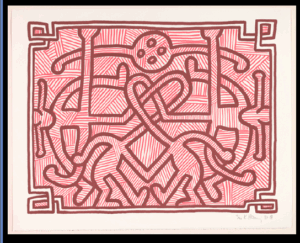
Keith Haring
American, 1958–1990
Chocolate Buddah 2, 1989
Lithograph, edition: 90
Yenna Hill
“I am not a beginning. I am not an end. I am a link in a chain.” – Keith Haring
This print comes from a portfolio that draws inspiration from mandalas, geometric devotional images used in Buddhism and other faiths. Here, Haring borrows the mandala’s symmetrical format, but fills his composition with his signature cartoon-like figures. Their limbs intertwine, forming abstract patterns as well as a central heart.
Haring wanted everyone to feel welcome to find their own meaning in his art. How would you interpret this print?
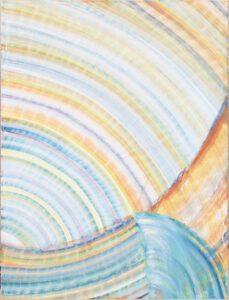
Danielle Riede
American, born 1976
Love in Orange, 2022
Oil with textured gesso on canvas
Gift of Danielle Riede, Courtesy Garvey|Simon NYC, 2023.
(2023.18.2)
Riede lends her experience as a lifelong dancer to her painting, translating movement into gesture on her abstract canvases. Beginning with an intuitive movement off the canvas, such as the arc of an arm, she then records that same movement in paint. She is also inspired by nature’s motion: lava flowing, ocean waves rippling, rays of sunlight streaming.
Riede has developed a special technique to build up texture in works like this one, applying layers of gesso made from calcium carbonate, a material found in eggshells, limestone, and chalk, that behaves much like plaster. The result suggests tidal motion beneath the surface.
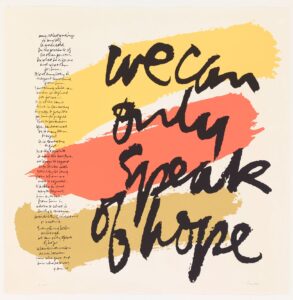 Corita Kent
American, 1918–1986
to love is to expect, 1972
Screenprint, edition: 200
Printer and publisher: Harry Hambly, Santa Clara, CA
Purchase: Gift of Paul K. Kania, 2021. (2021.9.4)
“I still have the feeling when I read something that’s very exciting… that it would be nifty to have that out of the book and onto the wall where you would see it more often.” – Corita Kent
Throughout her career, Kent made art that focused on text. This work excerpts a passage by philosopher Gabriel Marcel, exploring the relationship between our
sense of self and our love for others.
Kent created this work several years after leaving the Immaculate Heart of Mary, the
Catholic community where she had been a nun for over three decades.
While her prints had previously focused on finding the spiritual in the everyday, her later works, like this one,
often contemplated secular themes.
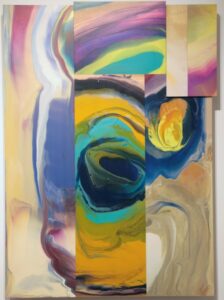
Sam Gilliam
American, 1933–2022
Element, 2008
Acrylic on birch
Gift of Sam Gilliam, 2018. (2018.8)
Sam Gilliam emerged from the Washington, D.C. scene in the mid-1960s to become one of the great innovators of abstract painting. This painting is part of a group of works that Gilliam called “constructed surprises.” He made these paintings by pouring and mixing paint on birch plywood, then cutting apart the boards and reassembling them. This process is related to the revolutionary painting method Gilliam developed in the late 1960s with his so-called Drape paintings, which involved pouring paint onto unstretched canvas and then hanging the canvas as a three dimensional artwork.
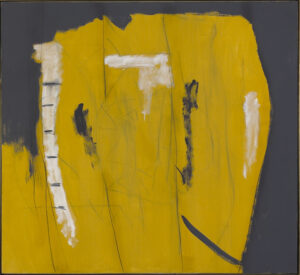
Robert Motherwell
American, 1915–1991
Wall with Graffiti, 1950
Oil and charcoal on linen
Purchase: Gift of Estelle Reninger and Gift of The Dedalus Foundation, 1994. (1994.24)
Robert Motherwell started his paintings with something he called automatic drawing—random marks on the canvas meant to capture the subconscious. He painted Wall with Graffiti when he was completing a mural at a synagogue in Millburn, New Jersey. Although this painting is abstract, some elements suggest Old Testament references: for instance, the long white stroke at the left, covered with horizontal black marks, brings to mind Jacob’s Ladder, stretching from earth to heaven, and the Diaspora is indicated by a scribbled line drawing which suggests the wandering paths of the scattered tribes.

Gunther Gerzso
Mexican, 1913–2000
Geminis, 1961
Oil on Masonite
Gift of Rodale Family, 2017. (2017.25.1)
Gunther Gerzso described his abstract paintings as “landscapes of the spirit.” While he drew inspiration from the European modernists he worked with earlier in his career, by the 1960s he had turned his attention to the power he saw in Mexico’s terrain and pre-Columbian past. Here, his careful brushwork creates layers of earth-toned forms, and suggests hidden depths.
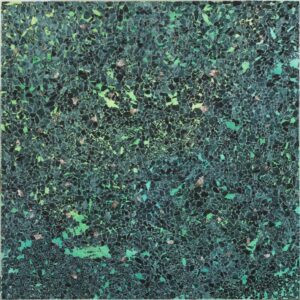
Alteronce Gumby
American, born 1985
Freedom Only Known to Them in
Whispers and Tales, 2022
Gemstones, willemite, calcite, glass and acrylic on panel
Purchase: SOTA Print Fund, 2023. (2023.1)
For this work, Alteronce Gumby assembled glass, minerals, and other unconventional materials into mosaic-like arrangements to evoke swirling galaxies and distant nebulae, a nod to the artist’s lifelong fascination with the cosmos and its infinite possibilities. The minerals used here—green willemite and red calcite—are fluorescent and glow when exposed to ultraviolet (UV) rays.
In only being observable under ultraviolet light—and otherwise undetectable by the human eye—these fluorescing minerals also become an apt metaphor for Gumby’s larger practice, which addresses issues of visibility and invisibility, and aims to challenge our assumptions about color by inviting us to think more expansively about it.

Stanya Kahn
American, born 1968
No Go Backs, 2020
Super 16mm film transferred to 2K video, color with sound, 33 minutes
©2020 courtesy of the artist
Stanya Kahn is a Los Angeles–based multidisciplinary artist whose practice spans film/video, performance, drawing, writing, painting, and sculpture. Her work blends humor and vulnerability with incisive social critique, engaging the psychological and political complexities of contemporary life. Through non-linear narratives, a diaristic voice, and surreal scenarios, Kahn explores themes of power, anxiety, agency, and resistance. Her practice often collapses the boundary between public and private experience, foregrounding how individuals navigate systems of control, intimacy, and identity through a raw and immediate engagement with fundamental human questions.
Shot on Super 16mm film with an original score and no dialogue, Kahn’s No Go Backs (2020) is an allegorical epic about an entire generation that must make a new way forward in the face of global catastrophe. The film follows two teenagers (Kahn’s teenage son, Lenny Dodge-Kahn, and his real-life best friend Elijah Parks) who flee the city of Los Angeles for the wild, only haphazardly prepared. In the precarity of a collapsed world, the kids travel in dreamlike states of distraction, malaise, and resilience. Traveling north into the monumental landscapes of the Eastern Sierra, they cut an arduous path along sites of California’s historic water wars. As they encounter other kids along shared roads, the film becomes a vision of tenuous survival, the prospect of camaraderie in facing the unknown, and the power of the natural world. Completed just before the start of the pandemic, No Go Backs appears as an urgent premonition amidst ongoing devastations.
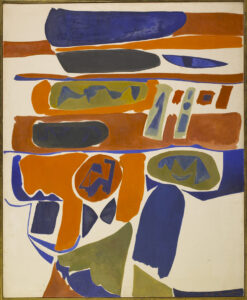
Will Barnet
American, 1911–2012
Clear Day, 1956
Oil on canvas
Gift of Abe Ajay, 1975. (1975.26)
In this landscape depicting Provincetown, Massachusetts, Barnet creates tension between flat, colorful shapes and a white ground. This abstract style—called Indian Space painting—uses Indigenous aesthetics to reimagine European Cubism. The white artists leading this movement believed that drawing inspiration from Native art would set them apart from European artists: Barnet described Indian Space painting as “real American art.” Do you agree? What do you think makes an artwork American?
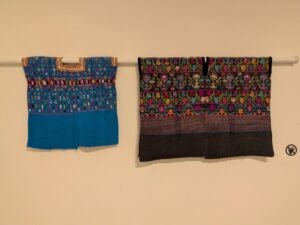
Far left:
Artist once known
Maya
Huipil, twentieth century
Cotton plain weave and brocade with lace and braiding
Gift of Mr. and Mrs. Herman L. Finkelstein, 1985. (1985.27.26)
Near left:
Artist once known
Maya
Huipil, twentieth century
Cotton plain weave and brocade with cotton velvet trim
Gift of Mr. and Mrs. Herman E. Finkelstein, 1984. (1984.41.25)
Historically, each Maya community in Guatemala had specific weaving and embellishment traditions for their clothing. The huipil on the far left organizes its animal motifs into thin registers with a chevron section across the middle indicating the wearer was from San Lucas Tolimán, Guatemala. The one on the near left has elaborate floral motifs and ceremonial chalices which identifies the wearer from Comalapa, Guatemala.
Many Maya today still wear huipiles and other traditional garments, but have embraced a more flexible approach to design that blends motifs and techniques from across traditions.
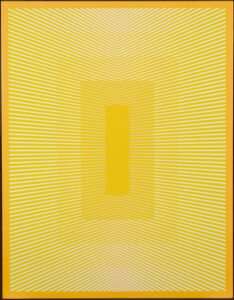
Richard Joseph Anuszkiewicz
American, born 1930
Converging Yellow Green, 1980
Acrylic on canvas
Gift of Dr. Jacob Bornstein, 1983. (1983.58)
The lines in this painting look like they are vibrating: this is because the painting’s dense stripes and contrast force your eyes to make constant tiny movements that bring different areas in and out of focus. Richard Anuszkiewicz was one of the founders of Op Art, a movement in which artists deliberately created optical illusions in their work. Many of his paintings use intense color and nesting shapes to play with viewers’ perception, creating art that is more about the experience of seeing than the painting itself.
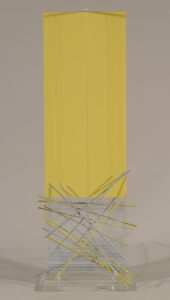
Jésus Rafael Soto
Venezuelan, 1923–2005
Multiple II from Jai-Alai, 1969
Plexiglas, wood, metal, nylon string, edition: 300
Gift of James W. Dye, 1979. (1979.56.6)
When you look at or walk around this multiple from Jai-Alai, the work looks like it is pulsing or rippling. Jésus Rafael Soto was fascinated by the idea of movement, which he believed was the next innovation for art to explore. This work not only has the appearance of motion, it also encourages viewers to move around the gallery to better examine it. Soto liked to use optical illusion with the goal of drawing focus away from the artwork itself and toward concepts like movement and time.
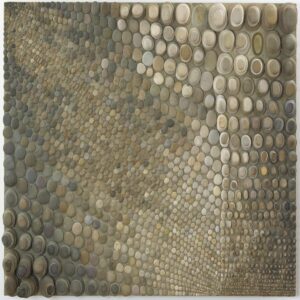
Mary Bauermeister
German, 1934–2023, active in United States 1962–1972
Untitled, 1965
River pebbles on fabric-covered panel
Gift of Carolyn Phillips Minskoff, 1991. (1991.20.1)
Bauermeister glued river rocks and pebbles onto this panel and added comments that question the relationship between art and nature. At upper right, she even labels a painted group of rocks “art,” forcing attention to how this work blurs lines between artwork and found object. Her notes invite us to understand her process, which is as much about ideas as the finished product.
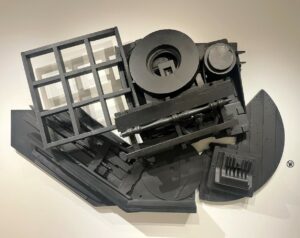
Louise Nevelson
American, 1899–1987
Mirror Shadow XXIV, 1986
Wood
RoBe Collection
Louise Nevelson foraged for the wood for her sculptures on the streets and loading docks of New York City. With attention to pattern, space, and balance, she looked past the everyday functions of objects such as window frames and banisters to use them as aesthetic elements. Her ability to transform such objects into imposing works of art made her one of the most significant sculptors of the twentieth century.
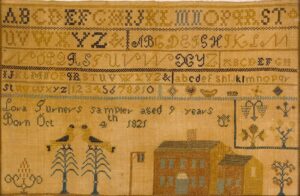
Lora Turner
American, born 1821
Sampler, 1830
Linen plain weave with silk cross stitch, long‑
arm cross, feather, rice, and eye stitch
embroidery
Gift of Mrs. William P. Hacker, 1979. (1979.80.45)
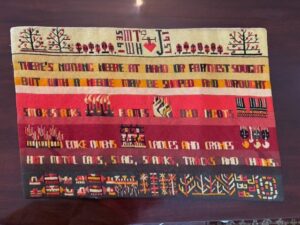
Mildred Johnstone
American, 1900–1988
Neere and Far, 1957
Wool tent stitch, French knot, and stem stitch embroidery on canvas
Collection of Margaret Thomas.
There’s nothing neere at hand or farthest sought
But with a needle may be shaped and wrought
Smokestacks, flames and ingots, coke ovens, ladles and cranes,
Hot metal cars, slag, sparks, tracks and chains
In this work, Johnstone adapts the 1640 poem “The Praise of the Needle.” While the original poem listed examples of flora and fauna that could be portrayed through embroidery, Johnstone replaces these with materials and tools of steelmaking. At the time when she made this work, she had spent nearly a decade creating inventive needlepoints inspired by Bethlehem Steel.
Johnstone chooses to present this reimagined text in the format of a sampler, like the one at left. From the 1600s to 1800s, schoolgirls made such samplers as an educational exercise. Johnstone plays on this history, asserting her artistic voice to reclaim embroidery as a form of expression for modern women.
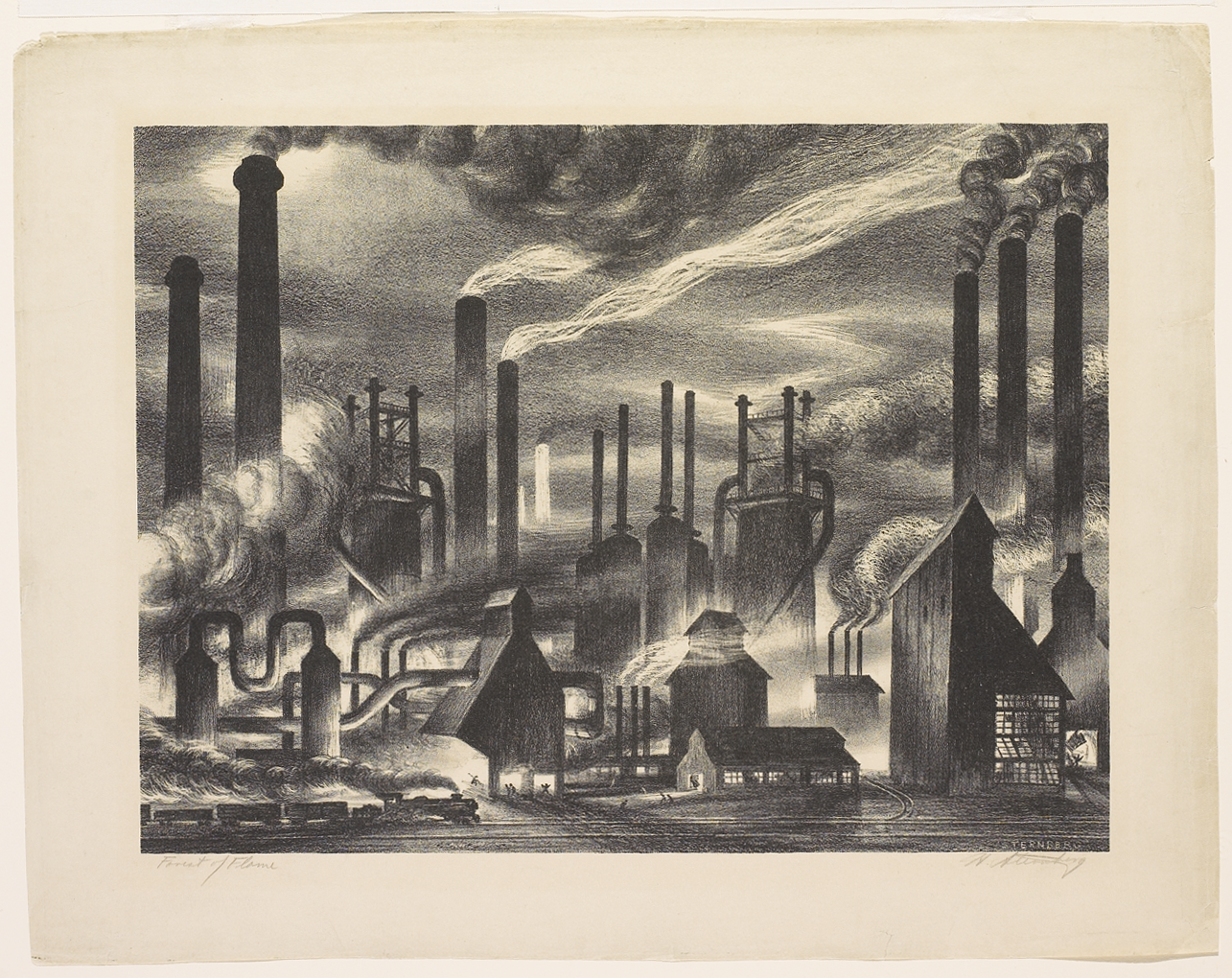
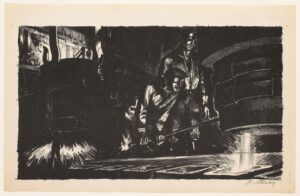
Harry Sternberg
American, 1904–2001
Forest of Flame, 1939
Lithograph
Printer: the artist
Purchase: SOTA Print Fund, 1995. (1995.27.5)
Harry Sternberg
American, 1904–2001
Open Hearth, 1937
Lithograph
Printer: the artist
Purchase: SOTA Print Fund, 1995. (1995.27.4)
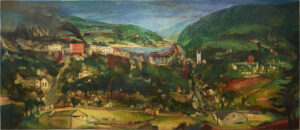
Franz Kline
American, 1910–1962
Lehighton, 1945
Oil on canvas
Purchase: Leigh Schadt and Edwin Schadt Art Museum Trust Fund, 2016. (2016.12)
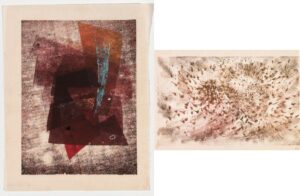 Harry Bertoia
American, 1915–1978
Far left:
Untitled, ca. 1940s
Monotype on rice paper
Near left:
Untitled, ca. 1952–56
Monotype on laid paper
Printer: the artist
Gift of Deborah S. Haight, 2001. (2001.6.2)
Purchase: SOTA Print Fund, 1992. (1992.5.7)
Harry Bertoia made monotypes at least once a week throughout his career. Many of his prints explore ideas about space and form related to his sculptures.
Bertoia had to be slow and careful when making his metal sculptures, but he could work quickly and spontaneously with his prints. He explained, “To do one, then the other, is refreshing and stimulating, and one medium can do what the other could not. Yet at times they merge into a single image.”
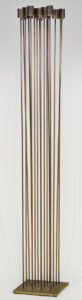
Harry Bertoia
American, 1915–1978
Tonal, ca. 1969
Copper and brass
Gift of Brigitta Bertoia, 1981. (1981.34)
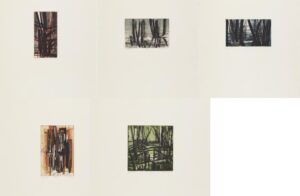
Terry Haass
French, born Czechoslovakia, 1923–2016
Left to Right:
Reflets 1–5 (Reflections 1–5), 1959
Etchings, edition: 50
Printer: the artist
Publisher: Atelier Lacourière et Frélaut, Paris, France
Gift of Paul K. Kania, 2022. (2022.7.2.1-5)
Terry Haass began working at Atelier 17, New York, under Stanley William Hayter in 1947 and even codirected the print workshop in 1951 when Hayter returned to Paris. Shortly after, Haass herself travelled to Paris to study color etching, a printing technique used in the works at right.
In this series, she combined her interests in astrophysics, philosophy, and archaeology to create prints inspired by light, time, and spirituality. The stark black lines and pooling color in each print transform windswept landscapes into nearly pure abstraction. The lingering somber mood is meant to invite viewers to reflect on the nature of the universe and their place within it.
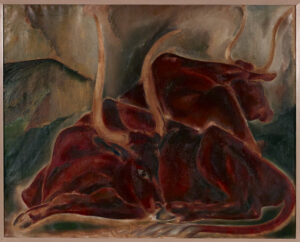
Elsie Driggs
American, 1898–1992
Oxen, 1926
Oil on canvas
Purchase: The Reverend and Mrs. Van S. Merle-Smith Jr. Endowment Fund, 1998. (1998.18)
Elsie Driggs is often associated with the Precisionists, a group of American artists who in the 1920s depicted the industrialization and the modernization taking place across a rapidly changing American landscape using precise lines and crisp geometric shapes. Here, however, Driggs finds formal beauty in two oxen, reveling in the rhythmically undulating forms of the animals and the surrounding mountains.
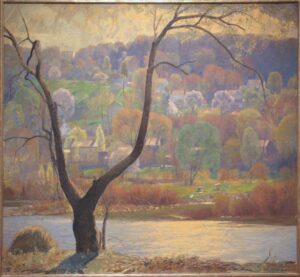
Daniel Garber
American, 1880–1958
Springtime, Tohickon, 1936
Oil on canvas
Partial gift by Anonymous Donor
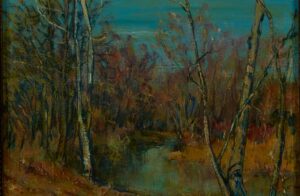
Walter Emerson Baum
American, 1884–1956
Untitled, undated
Oil on canvas
Gift of Stephen and Meg Barney, 2016. (2016.15)
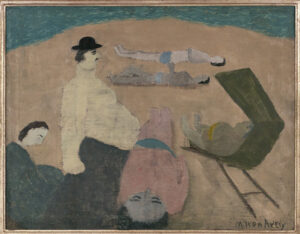
Milton Avery
American, 1893–1965
Coney Island, 1933
Oil on canvas
Gift of Milton Avery Trust, 1994. (1994.20)
This painting by Milton Avery—one of the most influential American artists of the twentieth century—represents the convergence of two major trends in art of the 1930s: social realism and modernism. The former is evident in Avery’s depiction of an ordinary scene at Coney Island, a beach popular at the time with working-class New Yorkers looking to escape the summer heat. Avery’s modernist treatment of his subject includes the painting’s tilted perspective, flattened forms, and multiple focal points.
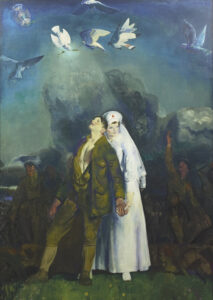
George Bellows
American, 1882–1925
Dawn of Peace, 1918
Oil on canvas
Purchase: Gift of Estelle Reninger, 1990. (1990.15)
Motivated by a patriotic response to alleged German atrocities during World War I, George Bellows spent more than eight months on this painting. It belongs to a series of at least fifty related works that he created about wartime themes. Bellows probably found inspiration for Dawn of Peace in idealized popular illustrations of Red Cross nurses―the new heroines of the era.
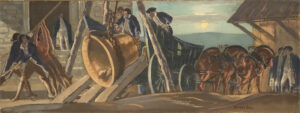
Gifford Reynolds Beal
American, 1879–1956
Hiding the Liberty Bell in Allentown, Pennsylvania, 1938
Oil on Masonite
Gift of the Family of Gifford Beal, 2006. (2006.9)
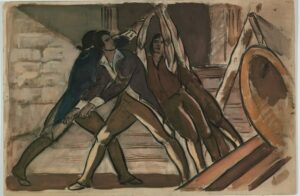
Gifford Reynolds Beal
American, 1879–1956
Far left: Hiding the Liberty Bell in Allentown, Pennsylvania, 1938
Oil on Masonite
Near left: Mural Study, Hiding the Liberty Bell in Allentown, Pennsylvania, 1938
Oil on board
Gift of the Family of Gifford Beal, 2006. (2006.9); Gift of Estate of Gifford Beal, 2007. (2007.20.4)
In the painting at far left, Beal depicts cavalrymen bringing the Liberty Bell into Allentown in September 1777. This bell was one of eleven evacuated from Philadelphia that year, to prevent the British from melting them down for ammunition. Beal imagined a dramatic moment, where locals and soldiers strained to hoist the weighty bell from the wagon. They would hide it in the basement of Zion’s Reformed Church on Hamilton Street.
Beal painted this scene as a study for one of ten murals for the Allentown Post Office. These murals illustrating local history were commissioned by the Works Progress Administration, a federal agency that initiated civic projects during the Great Depression to generate employment.
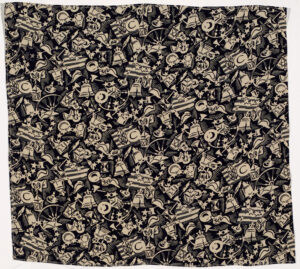
H.R. Mallinson & Company, Inc.
New York, NY, 1915–1937
“Liberty Bell” dress fabric from the George Washington Bicentennial series, 1932
Printed silk crepe
Gift of Kate Fowler Merle-Smith, 1978. (1978.26.461)
This fabric pairs symbols of the American Revolution—circles of stars, the Liberty Bell—with everyday objects from the colonial past, such as tricorn hats, dishes, and candles. This combination of motifs reflects the
fascination with colonial history and décor during the early decades of the twentieth century.
Known as the Colonial Revival, this movement expressed both national pride and nostalgia for simpler times.
While different in style, the two paintings at left also illustrate this renewed interest in commemorating the past.
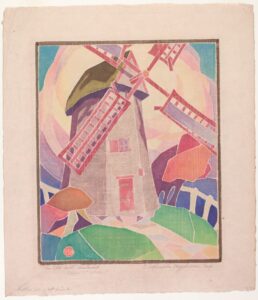
Ella Sophonisba Hergesheimer
American, 1873–1943
The Old Mill, Nantucket, ca. 1932
White-line color woodcut, edition: 75
Printer: the artist
Purchase: Mary M. Fuller by Exchange, 1992. (1992.22)
Allentown-born Ella Sophonisba Hergesheimer created this vibrant print using the white line color woodcut technique. This early twentieth-century innovation allowed artists to print multiple colors from a single woodblock, a process that previously required one block for every color. The method involved carving outlines around distinct areas of a composition and then applying variously colored water-based inks to each section before transferring the image to paper. Originating with the
Provincetown Printers in Massachusetts, the technique offered simplicity of execution as well as a painterly result.
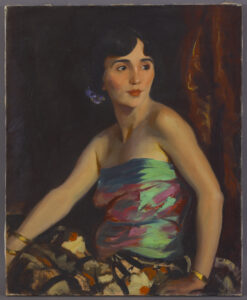
Robert Henri
American, 1865–1929
Isolina Maldonado—Spanish Dancer, 1921
Oil on canvas
Gift of Dr. and Mrs. John Altobelli, 1996. (1996.27)
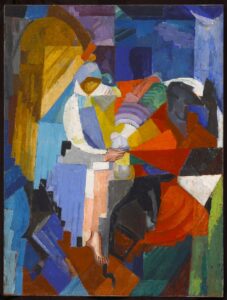 James Henry Daugherty
American, 1889–1974
Flight Into Egypt, ca. 1920
Oil on canvas
Purchase: General Acquisition Fund, 2001. (2001.4)
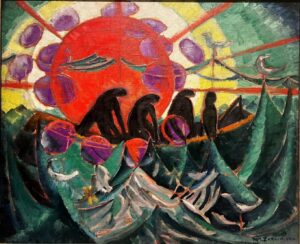
William Zorach
American, 1887–1966
Hauling the Weir—Provincetown, 1916
Oil on canvas
Private Collection
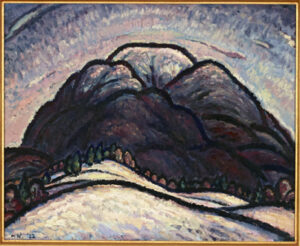
Harold Weston
American, 1894–1972
Giant Winter, 1922
Oil on canvas
Purchase: The Reverend and Mrs. Van S. Merle-Smith Jr. Endowment Fund, 1987. (1987.8)
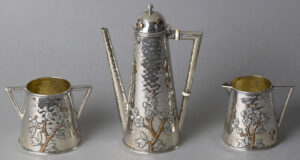
Whiting Manufacturing Company
American silver manufacturer, 1866–1924
Coffee Set, ca. 1880
Sterling Silver, copper, and ivory
Purchase: Gift of Edith M. Merkle in memory of Dr. Ralph Merkle, 2003. (2003.7.1.)
The asymmetrical arrangements of flowers and insects on this coffee service, as well as the use of mixed metals (as in the Japanese vase shown here), demonstrate the influence of Japanese art on American silver designers in the 1870s and 1880s.
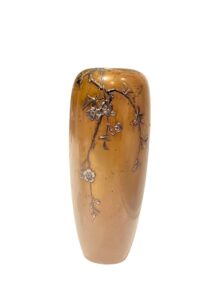
Yoshitsugu
Japanese, active late 1800s
Nogawa Company, manufacturer
Japanese, est. 1825
Vase with Tree Branch Motif
Mixed metal inlay
Gift of Mr. and Mrs. Herman Finkelstein, 1967. (1967.177.1)
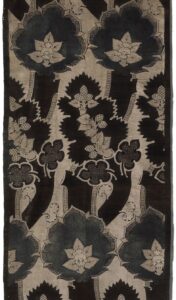
Mariano Fortuny y Madrazo
Spanish, active in Italy, 1871–1949
Length, ca. 1914
Silk velvet, block printed and stenciled
Gift of Kate Fowler Merle-Smith, 1974. (1975.42)
Mariano Fortuny y Madrazo established himself as an accomplished textile designer in Venice from 1906 to
his death in 1949. Fortuny took inspiration from a variety of historical styles ranging from Ancient Greece,
Renaissance Italy, Morocco, India, Spain, and Turkey. These influences blend in this velvet panel to create serpentine vines
with jagged leaves that resemble stylized flowers of Venetian Renaissance fabrics and pointed arches of Islamic architecture.
Rather than weaving motifs into the fabric itself, he instead printed on the surface in gold ink, using methods he had patented.
His medieval inspirations, dazzling pigments, and secretive techniques gave Fortuny a reputation as a fabric magician, and his
resulting garments were sought after for their mystical, ethereal quality.
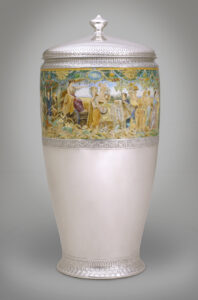
Louis Comfort Tiffany
American, 1848–1933
Tiffany & Company, manufacturer
New York, NY, 1837–present
Albert A. Southwick, designer
Presentation Vase with Cover, ca. 1915
Sterling silver with Limoges porcelain enamel decoration
Gift of Bethlehem Steel Co., 1985. (1985.25a, b)
Louis Comfort Tiffany was the son of Charles Lewis Tiffany, the famous jeweler and founder of Tiffany & Company. He started his career as a painter, becoming the firm’s chief designer after his father’s death in 1902. This vase reproduces, in enamel, two Louis Comfort Tiffany paintings representing the Roman goddesses Flora and Ceres, and their retinues. The enamel was thinly applied, allowing the engraved sketch to show through.
Tiffany & Company had participated in every world’s fair since the Paris Exposition of 1855, and thus gained an international reputation. This urn was created as a demonstration piece for San Francisco’s Panama-Pacific Exposition. It showcases the quality and sumptuousness of Tiffany products, in order to entice clients to place orders. In 1922, it was presented to Charles M. Schwab, chairperson of Bethlehem Steel, on the occasion of his sixtieth birthday.
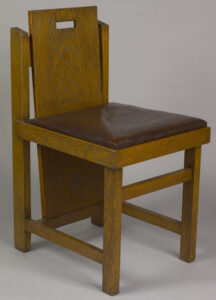
Frank Lloyd Wright
American, 1867–1959
Side Chair, ca. 1903
Oak and leather
Gift of Deborah S. Haight, 1997. (1997.6)
Frank Lloyd Wright designed this chair for a house he built for the Little family in Peoria, Illinois. When the Littles moved to Minnesota and had Wright design another house for them, they brought some of the furniture with them. This chair may, in fact, have been used in the library you see through this window, which is from the Little’s Minnesota home.
Unlike other progressive designers of his era, Wright drew inspiration from machine production. In this rectilinear chair, he makes obvious use of plain, machine-produced boards. The simplicity of his design highlights the beautiful arrowhead shapes in the wood’s grain, which can be seen on the chair back.
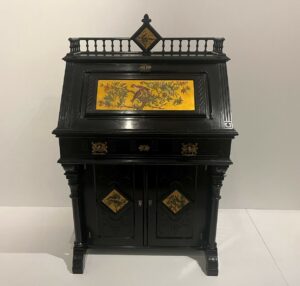
Attributed to Allen and Brother
Philadelphia, PA, active 1835–1896
Aesthetic Movement Desk,
1875–1880
American cherry, maple, and walnut; gilt and painted slate tiles
Purchase: Gift of Edith M. Merkle in Memory of Dr. Ralph Merkle, 2005. (2005.26)
This desk achieves an “artistic” look by evoking Japanese lacquer—with a little Gothic-inspired carving added for good measure. To mimic lacquer’s dark polish, the manufacturer treated the desk’s wood with iron acetate: this created a chemical reaction called ebonizing that colored the wood black. The desk’s gold panels with nature scenes echo lacquerware’s decorated surfaces.
Members of the Aesthetic movement valued beautiful furniture because they believed an attractive home would improve everyday life.
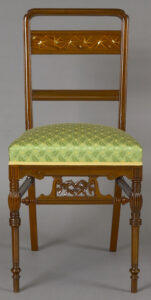
American or European
Side Chair, ca. 1880
Mahogany with mother-of-pearl, metal, and wood marquetry
Purchase: Gift of the King Family and General Acquisitions Fund, 2004. (2004.16.1)
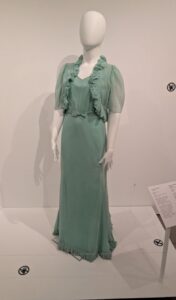
Artist once known
American
Dress, ca. 1935
Chiffon
Gift of the Ellie Laubner Collection, 2009. (2009.012.612 a, b)
This dress and the neighboring quilt share a distinctive color, Nile green. This muted blue- green hue was developed by American dye companies during the 1920s, and became hugely popular in the 1930s.
These companies’ ability to produce exciting new colors like Nile green came out of the 1917 Trading with the Enemy Act.
Under this wartime legislation, the U.S. confiscated German-owned patents, giving American firms access to the technology of the world’s top chemical suppliers. In less than a decade,
American dye companies dominated the market.
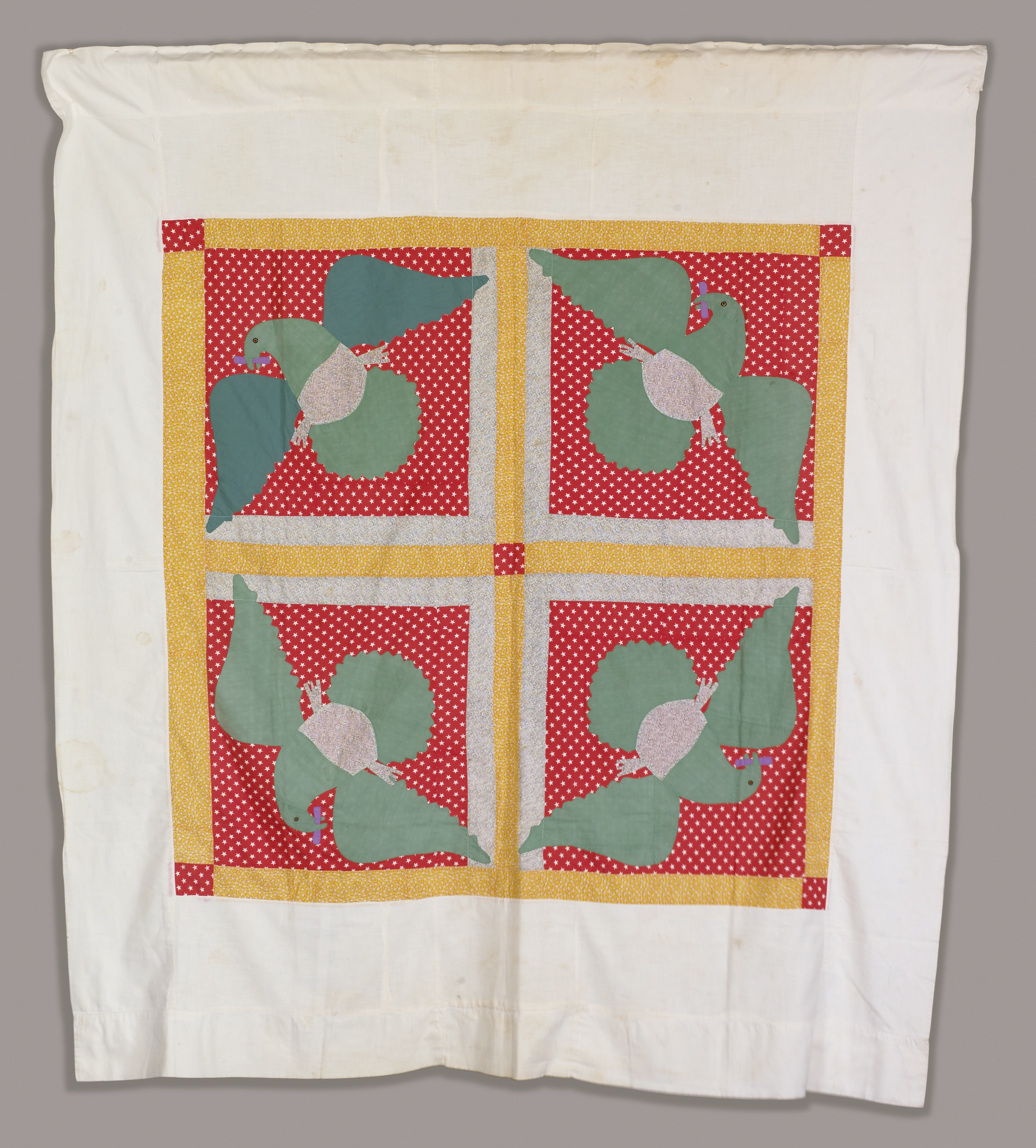
 Sonday Family
American
Patchwork, ca. 1930s-1940s
Cotton
Gift of Milton Sonday, 2007. (2007.21.4)
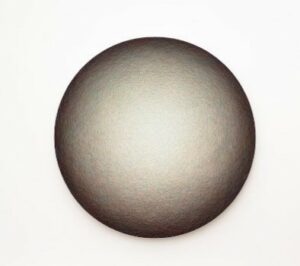
Emil Lukas
American, born 1964
Expander, 2020
Thread over wood frame with plaster, paint, and nails
Purchase: The Estelle Reninger Fund, 2022. (2022.1)
You may have noticed Emil Lukas’s “thread painting” Expander appearing to change as you approached it. Using simple materials to create a complex piece, the artist wrapped variously colored threads in painstaking fashion around a frame, producing an illusory depth and aura that deceives the eye. Lukas, who is based in northeastern Pennsylvania, works improvisationally but with intention. Every decision—the placement of a single thread a fraction of an inch one way or another, the color of that thread, and the layering—contributes to the overall effect on the viewer’s perception.
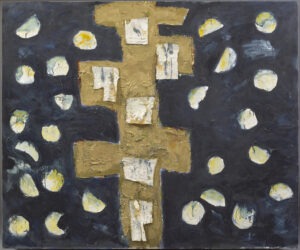
Joan Snyder
American, born 1940
Moon Theater, 1986
Oil, acrylic and linen on canvas
Purchase: Gift of Sam Spektor and Ann Berman in Honor of Bernard Berman, 1989. (1989.42)
Moon Theater presents not one moon but a bounty of twenty-six. These are scattered around a stylized tree/crucifix form, a recurrent motif in Snyder’s work that symbolizes life and death. Snyder’s emotional paintings challenged the impersonal nature of male-led art movements like Minimalism, and made her an influential feminist artist. She explained, “Making art is, for me, practicing a religion. … My work is my pride, creates for me a heritage. It is a place to struggle freely at my altar.”
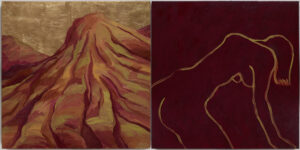
Kay WalkingStick
American, born 1935
Blame the Mountains III, 1998
Oil and brass leaf on canvas (left panel); oil on canvas (right panel)
Gift of David Echols, 2011. (2011.11a, b)
In this painting, the sensual curves of the female figure complement the rugged mountains. Kay WalkingStick’s series Blame the Mountains was inspired by the end of a romantic relationship during a trip to the Dolomites, a mountain range of northern Italy.
An important component of Easton-based WalkingStick’s identity is her Cherokee and Scottish-Irish heritage. She likes to create diptychs—artworks with separate panels that are joined together—which she states are “particularly attractive to those of us who are biracial.”